
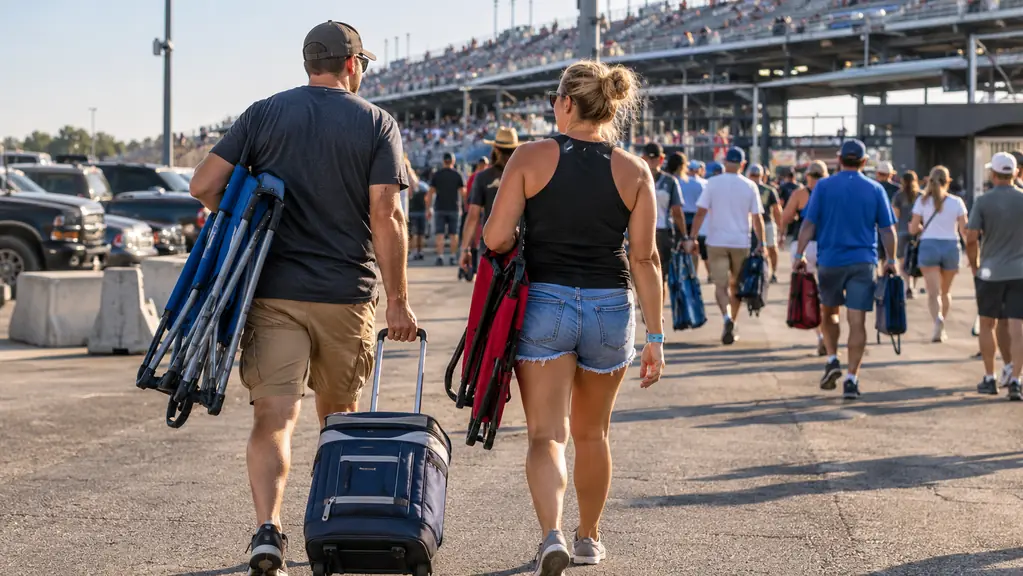
Short answer: for the walk from the parking lot to your seat, the Under Armour Sideline Pro cooler wins. I have carried mine into Bristol in April and into Talladega in October for two seasons running, and the thing that decides this comparison is not ice retention. It is the distance between where Linda and I park the truck and where we finally sit down. My left knee is bad and it has been bad for years. A cooler that rides against my hip on a haul handle is a different afternoon than a box I have to switch from hand to hand every hundred yards. One of those gets me to my seat in a decent mood. The other one does not.
The longer answer has a wrinkle in it. A hard cooler does one job better than any soft bag will ever do it, and that job is keeping ice alive through a hot afternoon. If you are packing drinks for six people and you want ice still rattling around at the checkered flag, a rotomolded hard cooler like the Yeti Roadie 24 is the right tool for that job. So this is not a question of which cooler is better in the abstract. It is a question of which one fits the way you actually go to a race. Those are two different trips, and I have made both of them.
| Under Armour Sideline Pro | Hard Cooler (Roadie 24 style) | |
|---|---|---|
| Capacity | 12 can size, and the listing says 12 or 24 cans with room for ice | Comparable, and hard coolers come in larger sizes if you need one |
| Ice at hour six | Fine on a mild day, water by midafternoon on a scorcher | Thick walls hold block ice or frozen bottles to the last lap |
| Empty weight | 1.1 pounds | Several times that before anything goes in |
| Carrying it a long way | One hand on the haul handle, rides against your leg | A strap on some models, but you are moving a heavier load |
| Hanging it off a rail | Built-in fence hooks | Nothing. It sits on the ground |
| Food that can get crushed | Soft sides, so sandwiches go on top and still shift around | Rigid walls, nothing gets squashed |
| Sitting on it or stepping up | No | It does that job all day |
| Storing it between races | Folds down and goes on a shelf | Takes a shelf of its own |
| Pockets for keys and sunscreen | Two exterior zip pockets | Usually none, or one small lid tray |
| Cleaning it out | Rigid interior liner wipes clean, BPA and lead free | Wipes out too, but it is a bigger tub to drain and dry |
| Warranty | Lifetime, per the listing | Varies by maker, so read the fine print |
Where the Under Armour Sideline Pro Wins
The empty weight is the whole argument. The listing puts the Under Armour Sideline Pro at 1.1 pounds, 11.5 inches tall by 13.5 inches wide by 8 inches deep, and I can tell you exactly what that number feels like on the ramp at Bristol. It feels like nothing. The first spring race we went to, I did it the hard way. I pulled an old rigid cooler out of the garage, the kind with a folding plastic handle, and carried it in from the far lot because that is where the line put us that morning. I swapped hands every fifty yards. Then I hugged it against my chest for a while to give my fingers a rest. Then I set it down twice on the concrete to shake my arm out, and by the time I reached the concourse my left knee had already made its opinion known and the day had not started yet. The soft bag carries in one hand by the comfort haul handle, rides against my leg instead of swinging out, and a dozen cans plus a bag of ice does not pull my shoulder down. A hard cooler of similar capacity starts several times heavier than that before a single can goes in it, and you feel every one of those pounds by the time you reach the top of your section.
The feature I did not expect to use at every single race is the pair of fence hooks. We sit near a rail at Talladega, and the bag hangs off it instead of soaking in whatever has collected on the concrete. That keeps the bottom of the bag clean and keeps it out of the way of people stepping past to reach their seats. The insulated quick-access lid is the other one. You flip it and take out a cold one without opening up the whole bag and letting the cold air out with it. Small things. Over six hours in a grandstand, the small things are the day. I learned that the slow way too. For a while I set a rigid box on the concrete between my feet, which meant I sat with my knees spread around it for four hours and stood up at the end stiff as a board. The bag hangs on the rail and my feet have somewhere to go.
Then there is what happens afterward. The two exterior zip pockets hold sunscreen, my phone and the truck keys, so I am not digging through ice for any of them. The coated outer fabric shrugs off dirt and spilled soda, and the rigid interior liner wipes out with a paper towel at the end of the day instead of holding a smell until October. The materials listed are BPA and lead free, and the warranty is listed as a lifetime one. Between races the whole thing folds down and goes on a shelf in the garage, which is more than I can say for a hard cooler.
Where the Hard Cooler Wins
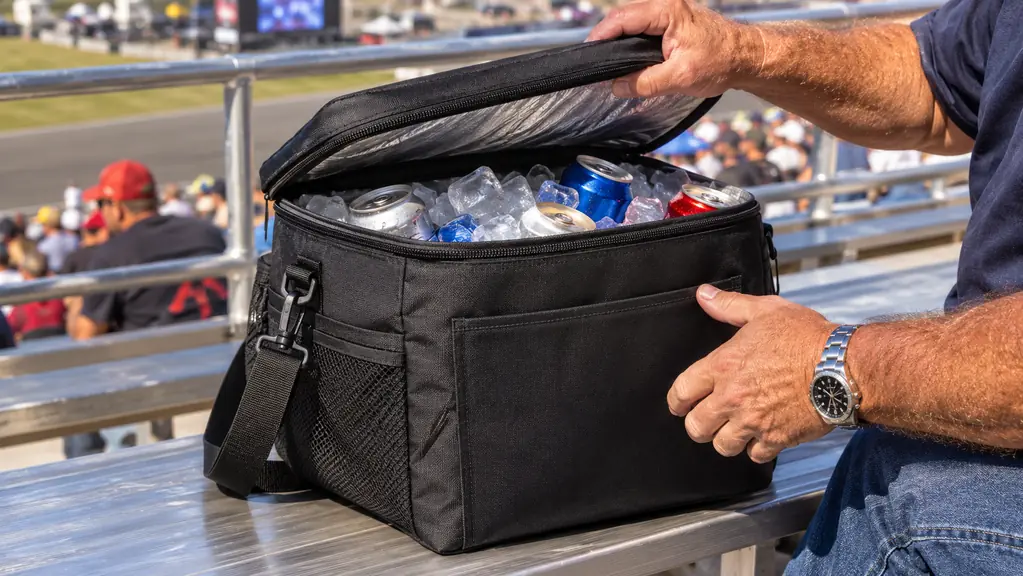
Now the other side of it, because a hard cooler is not bad gear. It is specialized gear. The walls on a rotomolded cooler are thick, and that thickness is the reason a block of ice or a few frozen bottles will still be cold at the last lap of a July race. My soft bag does fine from the gate to the checkered flag in April. Talladega in the fall is a different animal. We sat through an October Sunday there that was in the high eighties by the time they told the drivers to start engines, and there is no shade in that grandstand once the morning goes. I had packed two frozen bottles and a bag of ice over the cans, the same way I always do. Sometime in the middle of that race the ice was gone, the bottles were cool but not cold, and everybody was reaching into a puddle at the bottom of the bag. A hard cooler with a block of ice in it would have laughed at that afternoon. If cold drinks at hour six matter more to you than the walk in, the hard cooler is the honest answer, and I would not talk you out of it.
The rigid walls do a second job that soft sides cannot do. You can put sandwiches, a bag of chips, anything that would get crushed into a hard cooler and stop thinking about it. In mine, the food has to ride on top of the cans, and it still arrives looking like it was packed by a man in a hurry, which it was. A hard cooler also gives you something to sit on or step up on when you need it, and there is no version of that with a bag. But it weighs several times what the bag weighs before you put anything in it, it hangs on nothing, and at the end of the day you carry all of that back out to the truck.
Mine weighs 1.1 pounds empty. A rotomolded hard cooler is several times that before one can of anything goes in it.
The Cooler That Rides on My Hip Instead of Dragging Both Arms
Twelve cans plus ice, fence hooks for the rail, a quick-access lid, and 1.1 pounds empty. Two seasons at Bristol and Talladega and it still wipes clean with a paper towel.
Amazon Check Today's Price on Amazon →Read Your Track's Cooler Policy Before You Take My Word
I am not going to sit here and tell you that a soft cooler is allowed at your track, because I do not know your track. Bristol and Talladega each publish their own rules, and those rules cover cooler size, outside food and drink, and what kind of bag you can bring through the gate. They also change. What got through two seasons ago is not a promise about this season, and it is certainly not a promise about a different speedway in a different state.
So before you load up, go to the speedway's own website and read the posted cooler policy for the specific race you are attending, not the general FAQ page. If the language is vague, call the ticket office and ask an actual person. It takes ten minutes and it saves you standing at the gate while somebody explains that your bag is two inches too long to go in. Once I have that number in front of me, I do the measuring at the kitchen table in the winter, tape measure and all, 11.5 inches tall by 13.5 wide by 8 deep, and I hold it against whatever the speedway printed. Doing it in January means I have months to change my mind. Doing it in the parking lot with the truck running and the line moving means I own a bag I cannot carry in. Whatever you decide to buy, measure it against those posted numbers at home, not in the lot with the clock running.
How I Pack It on Race Morning
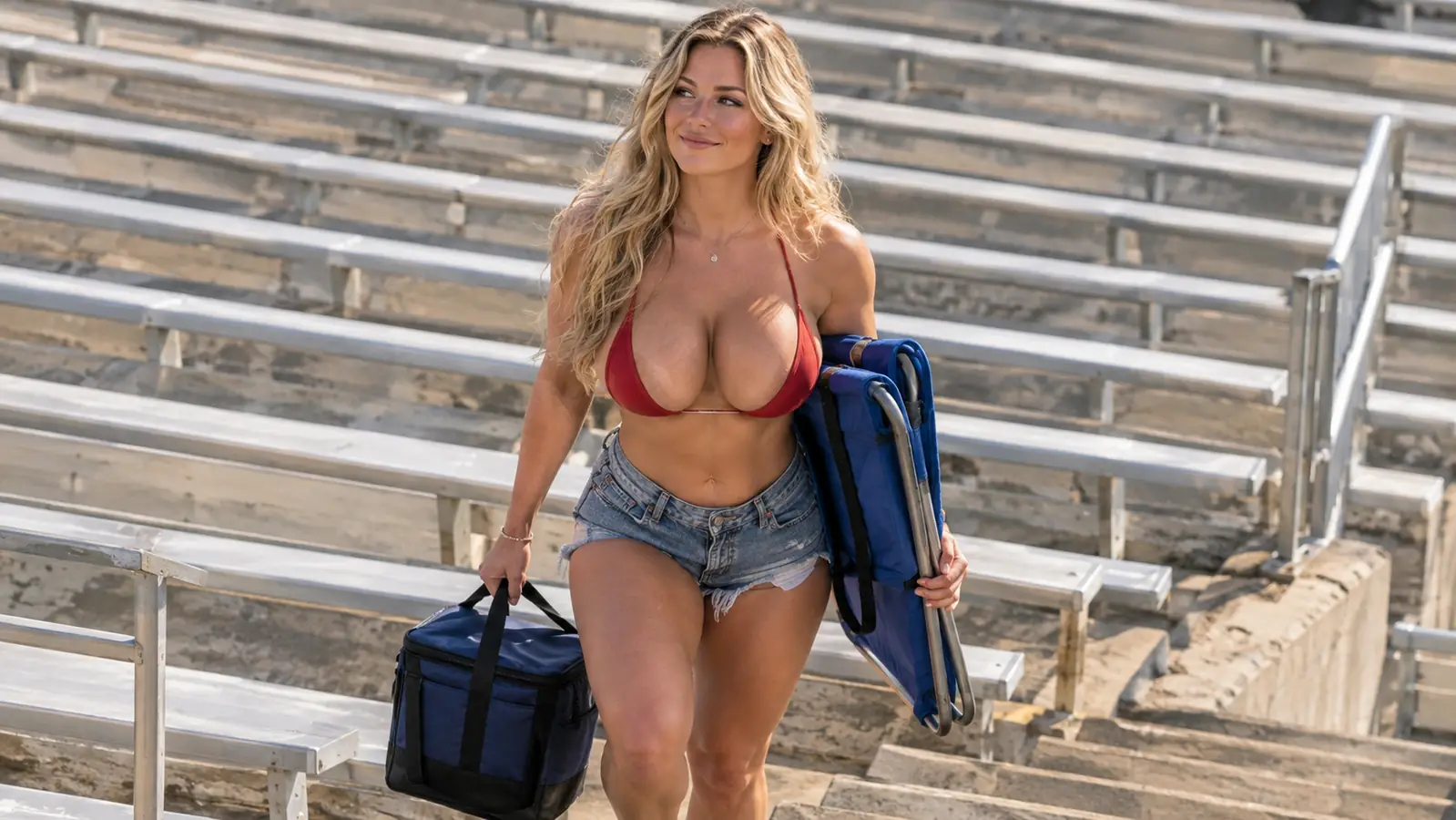
Two frozen water bottles go in the bottom. They work as ice and they are still cold enough to drink when the cans run low. That is the second version of how I pack it. The first version was loose ice poured straight over the cans, and that one afternoon taught me two things at once: the melt has to go somewhere, and where it goes is the bottom of the bag, where it turns the labels to mush and leaves you tipping the whole cooler over on the grass to drain it before you can lift it. Now the ice goes in a gallon zip bag and sits on top of the cans, so the cold falls down through them and the water stays where I can pull it out and dump it. Then the cans, upright, and the sandwiches on the very top, because the top is the one place in a soft bag where nothing gets crushed. The listing puts it at 12 or 24 cans with room for ice, and I pack the conservative twelve with ice every time.
Sunscreen goes in one exterior zip pocket, my cap in the other, phone and keys in whichever pocket I can reach without standing up. I load the cans in the night before and leave the ice bag in the freezer, so race morning is a two minute job instead of a search. Linda carries the two stadium seats, since I have enough going on with the cooler and the knee. Between races it folds flat and lives on a shelf in the garage, and on race morning it goes into the bed of the Silverado without my having to think about how I will fit it around everything else we bring.
Who Should Buy Which
Buy the Under Armour Sideline Pro if you walk a long way to your seats, if you are staying in a hotel and do not want a heavy box riding around in the room, if there are two of you, or if a knee or a back makes a one-handed carry worth more than a longer ice hold. It is also the one I would hand to somebody going to their first race, because it does not create a new problem to solve. It is a bag. You fill it, you carry it, you wipe it out, you fold it up.
Buy a hard cooler if you park close to the gate, if you tailgate for hours before the green flag, if there are five or six of you, or if ice at the last lap is the thing you care about most. It will outlast the day, out-cool the bag, and give you a place to sit. It will also be the heaviest thing you carry, twice, once in and once back out. And if you are honestly in the middle, start with the soft cooler. In my experience it is the one that ends up going to more than two races a year.
Check Your Track's Policy, Then Check the Cooler
12 cans plus ice, two zip pockets, built-in fence hooks, 1.1 pounds empty, lifetime warranty per the listing. Read your speedway's posted cooler rules first, then pack it and go.
Amazon See Today's Price on Amazon →