
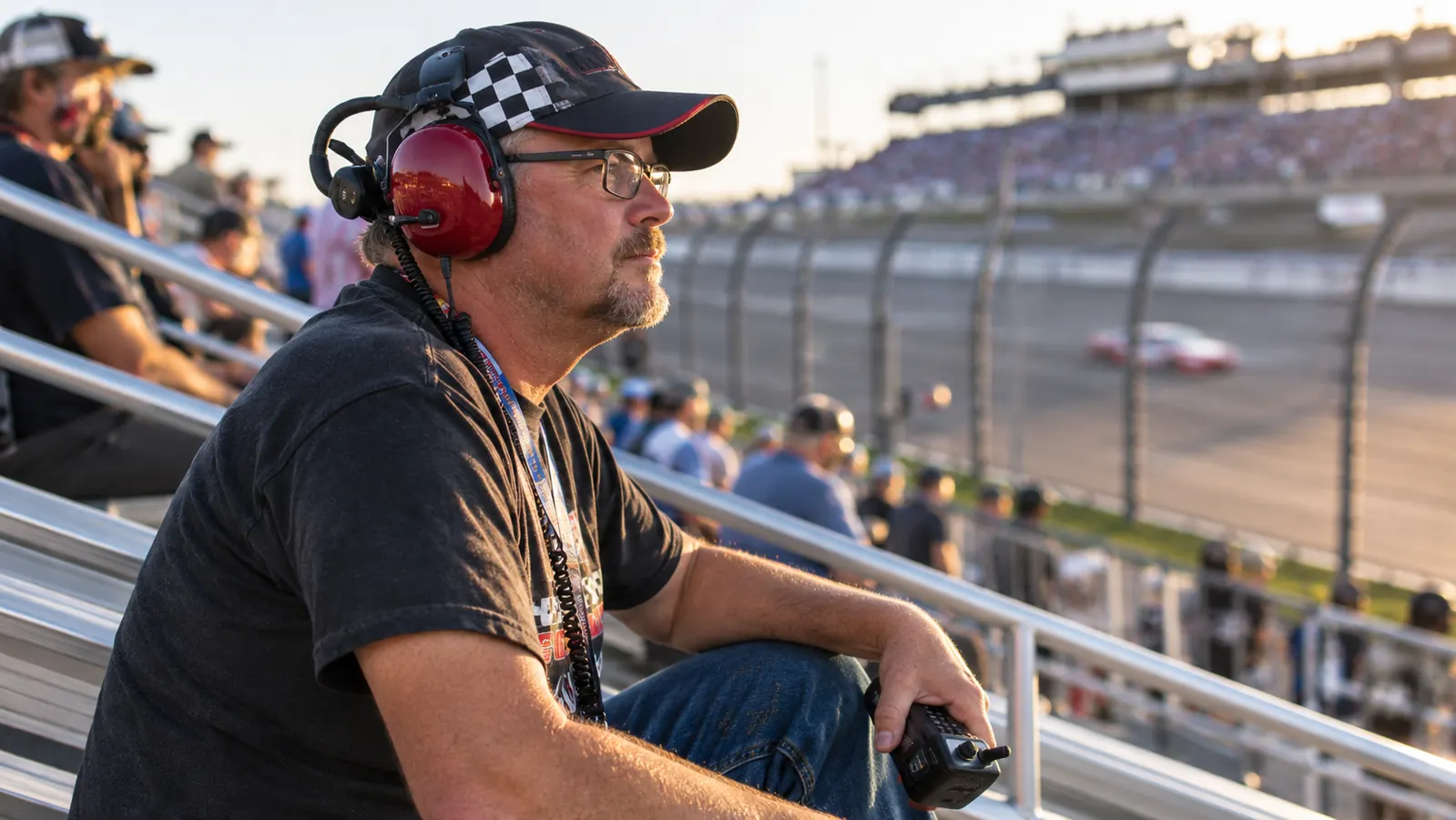
The guy two rows down at Bristol was running his scanner without a headset. That meant our whole section got to hear his race at the volume he was hearing it, which is how I ended up following somebody else's spotter for about thirty laps while my own driver was doing something I still have not seen the replay of.
I go to the spring race at Bristol and the fall race at Talladega, and for years I wore an over-the-head scanner headset that pressed my glasses into the side of my head by lap forty. I would take it off for a while to get some relief, which is the same as not bringing it at all. Three seasons ago I bought the Rugged Radios H41 behind-the-head headset to fix that one problem. It fixed it, and then it quietly fixed two more things I had not thought to complain about.
I am 61, I have a bad left knee, and I sit on aluminum grandstands for six or seven hours at a stretch. Gear has to earn its place in the truck. Here is what two full seasons at both tracks, plus a third season of owning it, have taught me about this headset.
The Quick Verdict
The behind-the-head band is the whole reason to buy it. Three seasons in, my glasses and my cap and my ears have all stopped being a problem, and 24 dB of protection is enough that I actually leave it on from green flag to checkered.
Amazon Check Today's Price →If your headset pinches your glasses by lap 40, start here
Behind-the-head band, 24 dB NRR, and a 3.5mm input jack for the scanner you already own. This is my third season with it and I have not gone back to over-the-head.
Amazon Check Today's Price on Amazon →How I've Used It
I bought it in the spring, three seasons back. That first season I only carried the Rugged Radios headset to Bristol. At Talladega that fall I left it in the truck out of pure habit and spent the whole race fighting with the old headset, which tells you how smart I am. Since then it has gone to both tracks, both races, every year, and it lives in the truck between trips.
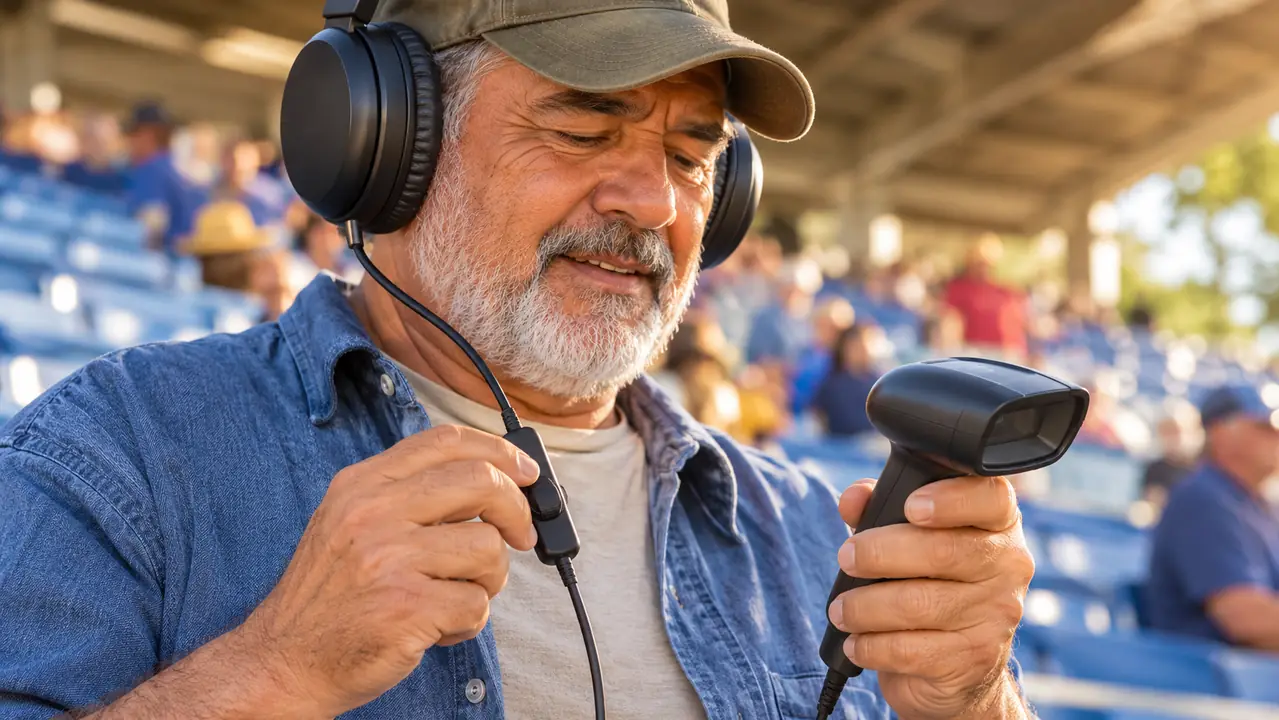
The rest of the routine does not change. Linda and I drive down in the Silverado, we stay in a hotel, and we get to the track early enough to be bored for an hour. She wears foam earplugs. I wear the H41. My scanner is an older handheld I have had for years and it is not going anywhere, so the headset goes into it through the 3.5mm input jack. I listen to team radio and the broadcast, I turn it down when the pack comes past and back up when they string out, and I do that all afternoon without thinking about it.
The two tracks are not the same job, either. Bristol is a bowl. The sound comes at you from every direction and bounces off the walls and never really lets up. Talladega is wide open and the field strings out and then comes back around all at once, so the volume swings more. The headset handles both without me adjusting anything except the dial when I want to. That sounds like a small thing. Over six hours it is not a small thing.
One thing to get straight before you buy. I have never used the boom microphone to talk to anybody. The listing describes it as an adjustable dynamic noise canceling microphone, and I have no reason to doubt that, but I am not talking to a crew chief and neither are you. Treat this as a listen-and-protect headset and you will be pleased with it. Buy it thinking you are going to chat with your buddy three seats over and you will be disappointed, because that is not the job it is doing.
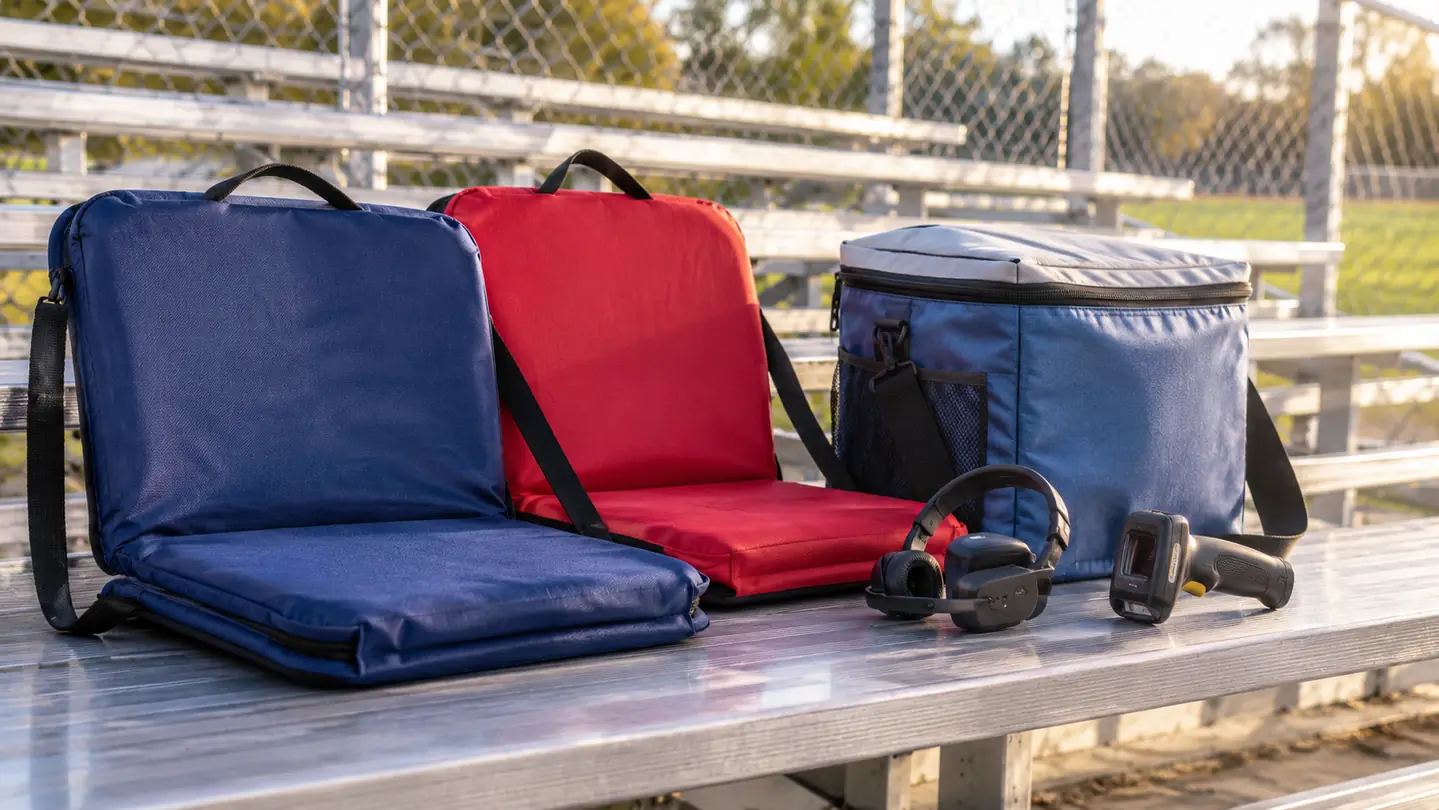
It has been rained on at Bristol, baked at Talladega in September, and tossed in the truck bed in a bag with two seat cushions and a cooler more times than I can count. Nothing has cracked. No earcup has gone dead. The band has not lost its shape. For gear that lives in a truck, that is the review right there.
What 24 dB of Hearing Protection Actually Feels Like
The listing puts the noise reduction at 24 dB NRR. I did not measure it and I am not going to pretend I did. What I can tell you is the difference in the same seat, at the same track, on a comparable Sunday.
Without anything on your ears, the field coming off turn four is a physical event. You feel it in your chest and you cannot hear the person next to you without shouting into their ear. With the H41 on, the cars are still loud, plenty loud, but the edge is off. I can hear the scanner clearly at a volume that is not hurting me. I can hear Linda say something without her leaning over. And when I walk back to the truck after the checkered flag, my ears are not ringing the way they used to be, which at my age is the part I actually care about.
The other half of it is that the sound stays where you put it. The scanner audio comes through the earcups and does not leak out to the folks around me, so I am not the guy two rows down who everybody can hear. That cuts both ways, of course. Nobody around you hears your broadcast, and you do not hear theirs, which is the entire reason I bought the thing.
Here is the test I actually ran, and it was not on purpose. At Bristol two seasons ago the race went long with cautions and we sat there close to seven hours from the time we walked in to the time we got back to the truck. I kept the headset on the entire time, including through the pace laps while they dried the track, and I never once pulled it off to get relief. On the old over-the-head set, hour three was where I started bargaining with myself about whether the broadcast was really worth it. That afternoon I never got to hour three in my head, because there was nothing to fight.
24 dB is not silence and it is not supposed to be. If you want the cars muffled down to nothing you are going to be disappointed by this or anything else at that rating. The trade is that the scanner comes through clean, the cups seal around your ears, and you can still hear the race you paid to see.
The Band Goes Behind Your Head, and That Changes Everything
The band on this headset sits behind your head instead of over the top of it. The earcups go around your ears. That is the entire design idea and it is the reason I bought it.
I wear glasses and I wear a cap, usually both at once, mostly for the sun. With the old over-the-head set I had to pick one. If I wore the cap, the band sat on the brim and rode up every time I looked down at my scanner. If I took the cap off, the band pressed the arms of my glasses into my temples and after an hour I had a headache I could feel behind my eyes. With the behind-the-head band, the glasses arms sit flat against the side of my head with nothing pushing on them, and the cap goes on top where it belongs. Three seasons and I have not had that headache once.
I tried three other fixes before I gave up and bought this, and I will save you the trouble. I tried sliding the old band back so it rested behind the crown of my head, which worked for about ten minutes and then it slid forward again every time I leaned back. I tried a thin beanie under the band to spread the pressure, which was unbearable by the second hour in September at Talladega. I tried taking my glasses off and watching the big screen, which lasted one race and told me exactly how much I had been missing. The behind-the-head band was the only thing that solved it rather than moving it around.
There is a small cost. A behind-the-head band takes two hands and a second to seat right, especially with a cap on, so it is not something you yank on one-handed while you are walking up the stairs with a cooler in the other hand. By the second race it was automatic and I do not think about it anymore. If you have long hair you may have to fuss with it the first few times. Linda tried it once and handed it back. That is the honest trade.
Getting My Scanner Into It
The reason I could use this at all is the 3.5mm input jack. My scanner has a headphone output, that goes into the jack on the headset, and I am done. No adapter hunting in a hotel parking lot at seven in the morning, no wondering whether the cable I grabbed out of the bag is the right one.
There is also a 5-pin universal radio port on it. That port is meant for a Rugged Radios radio, and I have never used it because I do not own one. If you already run one of their radios, that is the connection you care about and you can skip my whole section here. If you are a grandstand fan with an old handheld like mine, the 3.5mm jack is the story and everything else is detail.
The volume control matters more than it sounds like it should. When the field strings out and the broadcast goes quiet I nudge it up. When they come back around I nudge it down. I probably do that twenty times a race, and because the control is right where my hand already is, I never take my eyes off the track to find it. On the old set I had to look down and hunt for it, and I missed a pass more than once doing exactly that.
The first time I set it up at the track I made it harder than it needed to be. I had the scanner in my lap, the headset in one hand, a seat cushion under my arm and a cooler I was trying to wedge between my feet, and I was convinced I had the wrong cable. I did not. The cable was in the side pocket of the bag the whole time, I had just panicked. Now the headset goes in the bag already plugged into the scanner, and I pull the whole thing out as one piece and put it on. That two-minute setup on the aluminum is the only setup step there is.
Where It Falls Short
The boom microphone is dead weight for me. It is part of the product, it is fine, and I have used it exactly zero times in three seasons. If you are buying this purely to listen, you are paying for a microphone you will not touch. I have made my peace with it because nothing else about the headset annoys me, but you should know it comes with one.
It does not fold up small. It is an over-ear headset with a rigid band and it takes up the room it takes up, so it lives in a canvas bag in the truck rather than in a jacket pocket. The over-ear cups also get warm on a hot afternoon, and Talladega in the fall can still be a hot afternoon. I take it off between races and set it on the seat cushion, and that is enough for me. If you run hot, plan on the same.
And 24 dB, while it is a real number and I can feel the difference, is not the top of what hearing protection can do. If your main concern is your hearing above all else and you do not care about hearing a scanner, a good set of foam plugs or a higher-rated muff will beat it. Linda wears foam plugs and she is perfectly happy with the trade. The Rugged Radios headset is for the fan who wants both, and wanting both means giving up a little on each.
What I Liked
- The behind-the-head band leaves glasses and a cap alone, which is the whole reason it exists
- 24 dB NRR is enough that I leave it on from green flag to checkered
- The 3.5mm input jack takes the handheld scanner I already own
- Volume control sits right where my hand already is, so I never look away from the track
- Three seasons of rain, heat and truck-bed storage with nothing broken
Where It Falls Short
- The boom microphone is included and I have never used it
- A behind-the-head band takes two hands to seat, especially with a cap on
- It does not fold flat, so it needs a bag
- Over-ear cups get warm on a hot afternoon
- 24 dB is good protection, not the maximum available
Three seasons, two tracks a year, and the only thing I have had to replace is the canvas bag I carry it in.
Who This Is For
If you wear glasses to the track, this is close to a no-brainer. If you wear a cap all day and hate choosing between shade and a headset, same answer. If you already own a handheld scanner with a headphone jack and you want to hear team radio and the broadcast without giving up your hearing, the Rugged Radios H41 was built for exactly that. It suits the fan who sits for six hours and wants to stand up at the end without a headache and without ringing ears. And it suits anyone past sixty who has started to think about what forty years of race noise has already done.
Who Should Skip It
If you actually need to talk to people, this is not the tool and you should be looking at a two-way setup instead of a listening headset. If your only goal is maximum hearing protection and the scanner audio is secondary, a higher-rated muff or good foam plugs will do more for less. If you want something that disappears into a jacket pocket, this is not that. And if you mostly watch on the couch, none of this applies to you, because your living room is not going to hurt your ears.
The glasses fit is why I bought it. The 24 dB is why I still wear it.
Three seasons at Bristol and Talladega, plugged into the scanner I already had. If you are tired of choosing between your cap, your glasses and your ears, this is the one I would point you to.
Amazon Check Today's Price on Amazon →