
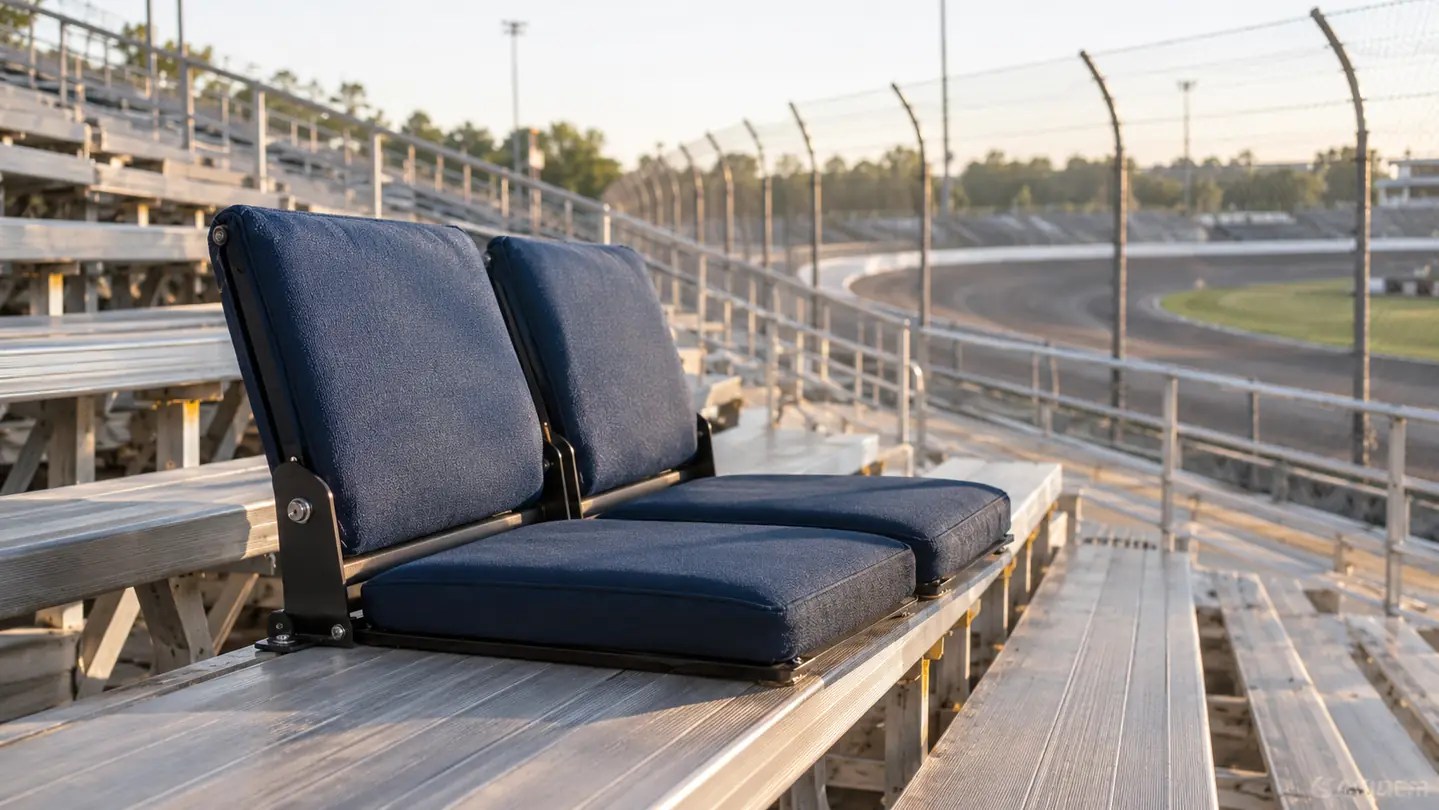
Two seasons ago I sat on bare aluminum at Bristol Motor Speedway, and my left knee told me within ten minutes that I had made a mistake. Forty years of machine work will do that to a joint. By the time the field came back around under the first caution I was already shifting my weight, and by halfway I was standing up every few laps to take the pressure off. Linda looked over somewhere around lap 200 and told me I was not going to make it to the checkered. She was right. We left early, and for a man who watches every Cup race he can get in front of, leaving early is about the worst thing you can do at a racetrack.
Before the next spring race we bought two Everlasting Comfort stadium seats with back support, one for me and one for Linda. Not because I had read anything about them. Because a man two rows down from us the year before had one, and I spent most of that afternoon envying it. Two seasons and four races later, through hot April Sundays at Bristol and windy fall afternoons at Talladega, those seats are the one piece of gear I would turn the truck around for if I forgot them. Here is what I have learned in that time, including the parts that are not perfect.
The Quick Verdict
Four races and roughly forty hours of sitting. The foam has not flattened, my knee has stopped deciding when we leave, and I would buy the pair again tomorrow.
Amazon Check Today's Price →The seat that got me to the checkered flag at Bristol
Same pair, two full seasons, no regrets. If your knee is picking your exit time, start here.
Amazon Check Today's Price on Amazon →How I've Used It
We bought two before the spring Bristol race two seasons ago. Mine lives behind the recliner in the basement race room between trips, and Linda's stays folded in the closet next to the cooler. On race weekends both of them ride in the back of the 2016 Silverado under a blanket, mostly so the sun does not bake them for the whole drive down. They have been to two spring races at Bristol and two fall races at Talladega, plus a handful of Saturday afternoons in the driveway when I was doing truck work and wanted something soft to kneel on.
The Everlasting Comfort seat sits on the aluminum bench and stays where I put it. That matters more than it sounds like it should. I have watched people fight a loose cushion all afternoon, re-seating it every time they stand up for a caution, and by the last stage they are sitting on it sideways and grumbling into their program. Mine has not slid on me yet, and the rows at Bristol are steep enough that a sliding cushion would be a genuine problem rather than an annoyance.
The other thing I noticed the first day is that the seat raises me off the aluminum, which does two things. My knees sit at a better angle instead of dangling, and I can see over the people in front of me a little better when the whole row stands up. Neither of those is printed anywhere on the seat. Both are the reason I carry it up the stairs.
What the Memory Foam Feels Like by the Third Hour
Most cushions feel fine for twenty minutes. The real test is hour three, when the cautions have piled up and you have not changed position since the green flag dropped. Everlasting Comfort uses high density memory foam as the fill here, and what that means in practice is that it does not bottom out. I can feel aluminum through a folded jacket by the second hour. I do not feel it through this.
It is firm when you first sit down. I want to be straight about that, because if you are expecting to sink into something like a couch cushion you will be disappointed for the first ten minutes. It warms up and settles under you. By the time the race is a third of the way along I am not thinking about the seat at all, and that is the highest compliment I can pay a piece of gear.
My knee is the real test. Bad left knee, the kind that aches when it stays bent too long and aches differently when it stays straight. The seat lets me shift. Sit square for a while, angle a little, put my left foot up on the bench below, drop it back down. Because the foam gives instead of fighting me, the shifting actually relieves something. On bare aluminum every shift was just moving the ache to a new spot.
The Backrest, and Why Mine Stays Where I Put It
The backrest is adjustable, and here is what that has meant for me. I run mine fairly upright early in the day and lean it back a notch during a long red flag. Linda runs hers further back than mine does. Neither of us has had to compromise, which is more than I can say for most gear we share.
What surprised me is how much the back support mattered by the end of the day. I expected the cushion to be the thing that saved my knee. It helps. But my low back is what used to get me. Six hours on a bench with nothing behind you and you are hunched forward by the last stage, and then you climb into a truck for the drive home. Having something to lean against for the whole race changed how I felt on Monday morning more than the cushion did.
It is armless, which I did not think about until I had sat in it a while. At a racetrack that is the right call. You are shoulder to shoulder with people on both sides, and arms would be in the way and in somebody's ribs. Nothing to fold down also means nothing to break.
Folding It Flat, Carrying It, and the Storage Pocket
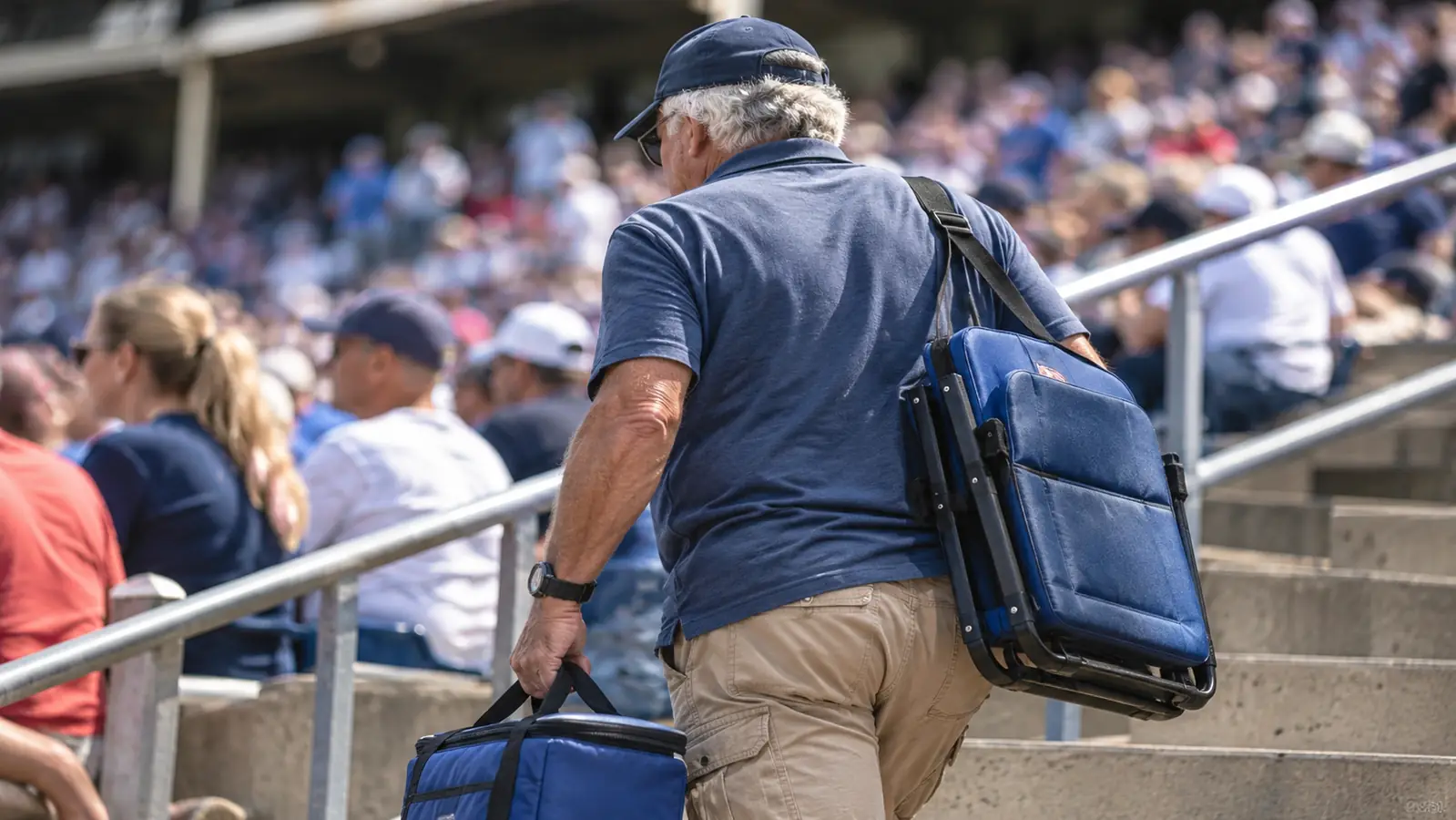
The Everlasting Comfort seat folds flat and it weighs about 2.2 pounds, which sounds like a line from a listing until you are the one walking in from the far lot. I carry mine by the built in strap over one shoulder, cooler in the other hand, and I make it up the grandstand steps without stopping to rest. At 61 with a left knee that grinds, that is the whole ballgame.
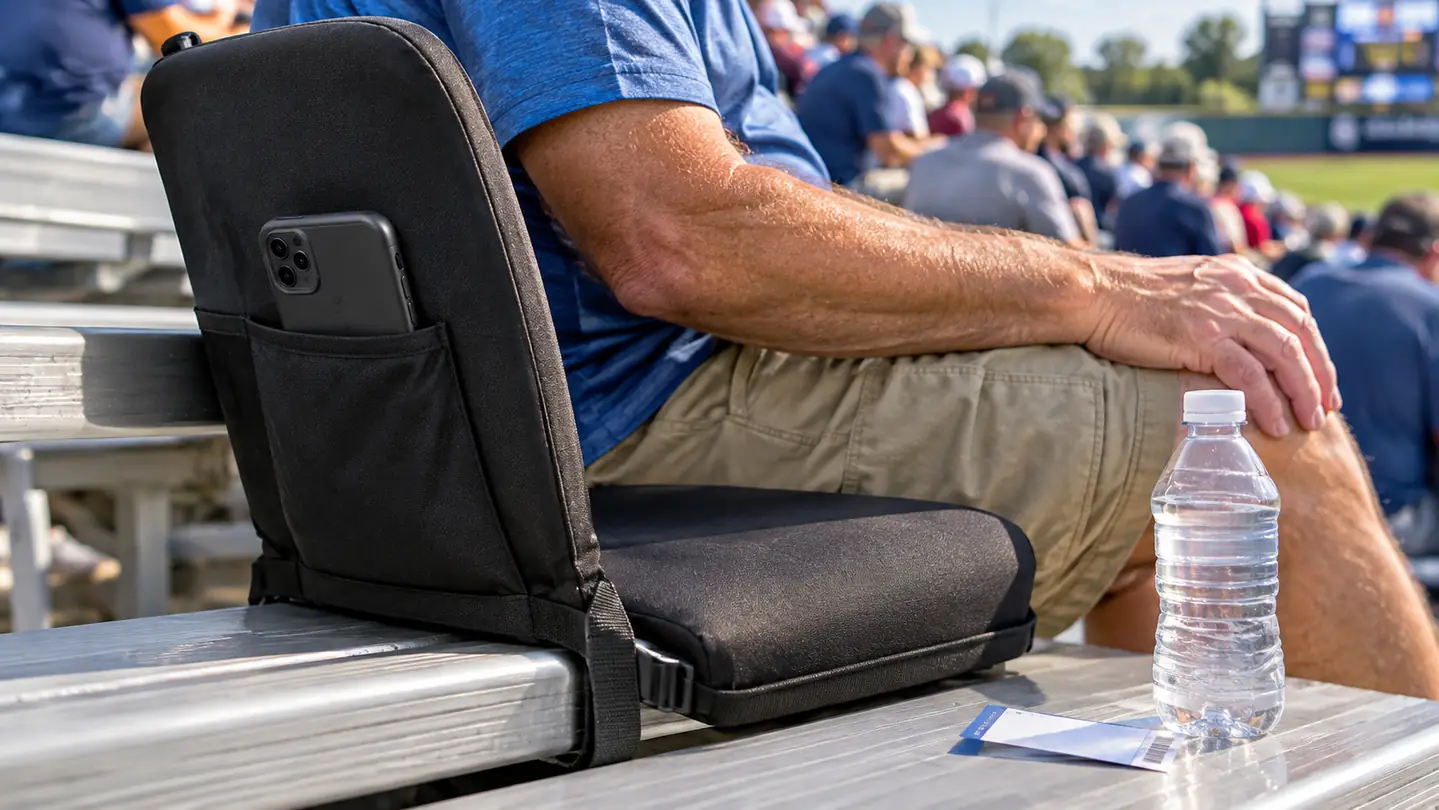
The storage pocket is small, and I want to set that expectation correctly. It holds a phone, a folded paper ticket, and a scanner earpiece. It is not going to swallow a program and a poncho. What it does is keep my phone out of my lap, where it would otherwise slide off onto the concrete every time I stand up for a restart. I have lost a phone that way at a track before. I would rather not do it again. The whole thing wipes clean with a damp rag, which I have tested against spilled soda and one memorable mustard packet.
Folding it up at the end of the day is a one hand job once you know the motion. The first time it took me longer and I looked like a man wrestling a lawn chair in the aisle. Linda still brings that up. By the second race I could do it without looking, which matters when twenty thousand people are all trying to get down the same set of stairs at once.
Two Seasons Later: What Held Up and What Did Not
Two seasons on the same pair of Everlasting Comfort seats, four races, call it forty hours of sitting, plus a lot of time folded in the back of the truck. The memory foam has not flattened anywhere I can find. The stitching has not let go. The strap still works. The wipe clean surface still wipes clean. The adjustable back still holds the angle I set it to instead of creeping down over an afternoon, which is the failure I expected and did not get.
The honest complaints. The polyester surface runs warm. It is not a breathable mesh, and at Bristol in April when it is 85 degrees with no breeze in the bowl, your back will sweat against it. I bring a hand towel and that solves it. Second, when the seat is folded and leaning against something in the truck bed, the back of it takes the knocks. Mine has a scuff. Nothing has cracked or torn, but I would not toss it off a tailgate onto gravel and expect it to look new.
Third, and this one is not the seat's fault, you have to remember it. Twice now I have gotten halfway to the gate and had to send Linda back for them. A seat that lives in the closet is doing you no good at the track. I have started keeping both of them in the truck from March through October so the decision is already made for me.
One thing I did not expect was the wind at Talladega. It comes across the top of that grandstand and anything loose in your row is going somewhere. Mine has not moved. I have watched a couple of seat pads get chased down the row by their owners, and that is a bad way to spend a caution. The seat is seventeen inches wide and ten and a half deep, which lines up with the bench spacing at both tracks we go to, so it is not crowding the person beside me any more than a man my size already does.
What It Does Not Fix
It is a cushion with a back on it. It is not a recliner, and it does not turn an aluminum bench into a stadium chair with arms and a cup holder. If your back needs real lumbar shaping, this gives you a padded panel and not much else. I have folded a small towel behind my lower back on long drives, but I have never needed it at the track.
It also does not fix the heat. Bristol in April can be 85 and dead still, and no seat is going to change the air in that bowl. It does not make the walk from the far lot any shorter either. It makes the sitting easier, which is the job it was hired to do.
One more thing that is nobody's fault: the rows are tight. If you are a big man, the seat takes up a little more room than you did on the bare bench, and the person next to you will notice. Linda and I sit together and split the difference. Sitting next to a stranger, I would take a second to make sure my shoulder is not crowding them.
What I Liked
- Memory foam that does not bottom out over six hours
- Adjustable backrest keeps my low back off the aluminum
- Folds flat at about 2.2 pounds with a strap I can carry over one shoulder
- Sits steady on the bench and stays put through a windy afternoon
- Wipes clean with a damp rag, including spilled soda
- Two seasons and four races in, nothing has flattened or torn
Where It Falls Short
- Polyester surface runs warm and clammy on a hot, still afternoon
- Storage pocket is small, phone and ticket only
- Firm for the first ten minutes until it warms up
- No arms and no cup holder, which is fine at a track and worth knowing before you buy
Two seasons, four races, about forty hours of sitting, and the foam has not flattened anywhere. My knee has stopped being the reason we leave early.
Who This Is For
Anyone whose knee, hip, or low back does not care for six hours on aluminum. Anyone who has left a race early, or stood in the concourse for the last fifty laps because sitting hurt worse than standing. Anyone sitting in the grandstand rather than a suite, which is most of us.
It is also for the person who goes to two or three races a year and wants to buy one thing and be done with it. You buy a pair, they live in the truck during the season and in the closet the rest of the year, and you stop thinking about the bench underneath you. That is worth more than it sounds. And if you are on the fence about whether a seat does anything a folded blanket does not, the honest answer is that the blanket stops helping around hour two.
Who Should Skip It
If the seat at your track already has a back on it, you do not need this. If you go to one race every five years and you are comfortable on aluminum, a stadium blanket is enough and it packs smaller.
If you are flying to a race and packing light, this is one more thing to carry. It folds flat and it is light, but it is still a thing, and it will not fit in a carry on next to a weekend of clothes. And if you want a seat that reclines and has armrests, this is not that seat. It is a cushion and a back, and it does those two jobs well. Before you carry anything into a track, check that track's posted rules on what is allowed through the gate, because they are not all the same.
The one piece of gear I would turn the truck around for
Two seasons on the same pair. If your knee is the reason you leave early, this is the simplest fix I have found.
Amazon Check Today's Price on Amazon →