

I bought the Rugged Radios H41 three seasons ago, and I did it for a selfish reason: my old over-the-head headset pressed the arms of my glasses into my temples by the halfway point of a Cup race. By the time we got back to the hotel in Bristol, I had a headache behind my eyes and a line across the top of my head. I wanted a scanner headset that let me wear my cap, keep my glasses on, and still hear the team radio and the broadcast. This is the honest version of how that has gone, including the parts I do not love.
The short answer is that the Rugged Radios H41 has solved the problem I bought it to solve. It is a behind-the-head headset with a 24 NRR hearing protection rating, a volume control, and a 3.5mm input jack that plugs into my older handheld race scanner. I wear it over my ears, with the band behind my head instead of across the top. I am 61, I live in Hamilton, Ohio, outside Cincinnati, and I have a bad left knee. Comfort details matter to me more than spec-sheet bragging. That is the lens this review comes through.
The Quick Verdict
A real fix for glasses and cap wearers who listen to a scanner, with a fit that takes practice and a microphone I have never needed.
Amazon Check Today's Price →If your glasses and cap are the reason you hate your old headset, start here.
The H41 is the first headset I have worn for a full race without a pressure headache. It is not the right pick for every fan, but it is the right pick for my kind of Sunday.
Amazon See the Rugged Radios H41 on Amazon →How I've Used It for Three Seasons
I bought the H41 after a spring race at Bristol where my old headset spent more time pushed up on my forehead than on my ears. The over-the-head band and my glasses were fighting each other. I had read about behind-the-head headsets but assumed they would feel loose or fall off when I stood up. They do not, at least not this one. The band sits behind my head, the cushions sit around my ears, and my cap goes on the way it always does. That alone made the change worth it for me.
I use it at the two races I go to in person, the spring Bristol race and the fall Talladega race, and I use it in the basement race room when I want to listen to scanner audio without turning the TV up. I plug the 3.5mm jack into my own handheld scanner, an older model I have had for years. I am not a crew member and I am not talking to anybody. I am listening to team radio and the broadcast, and I am protecting my hearing while I do it. Linda wears foam earplugs. She has no interest in a headset, and I do not push it on her.
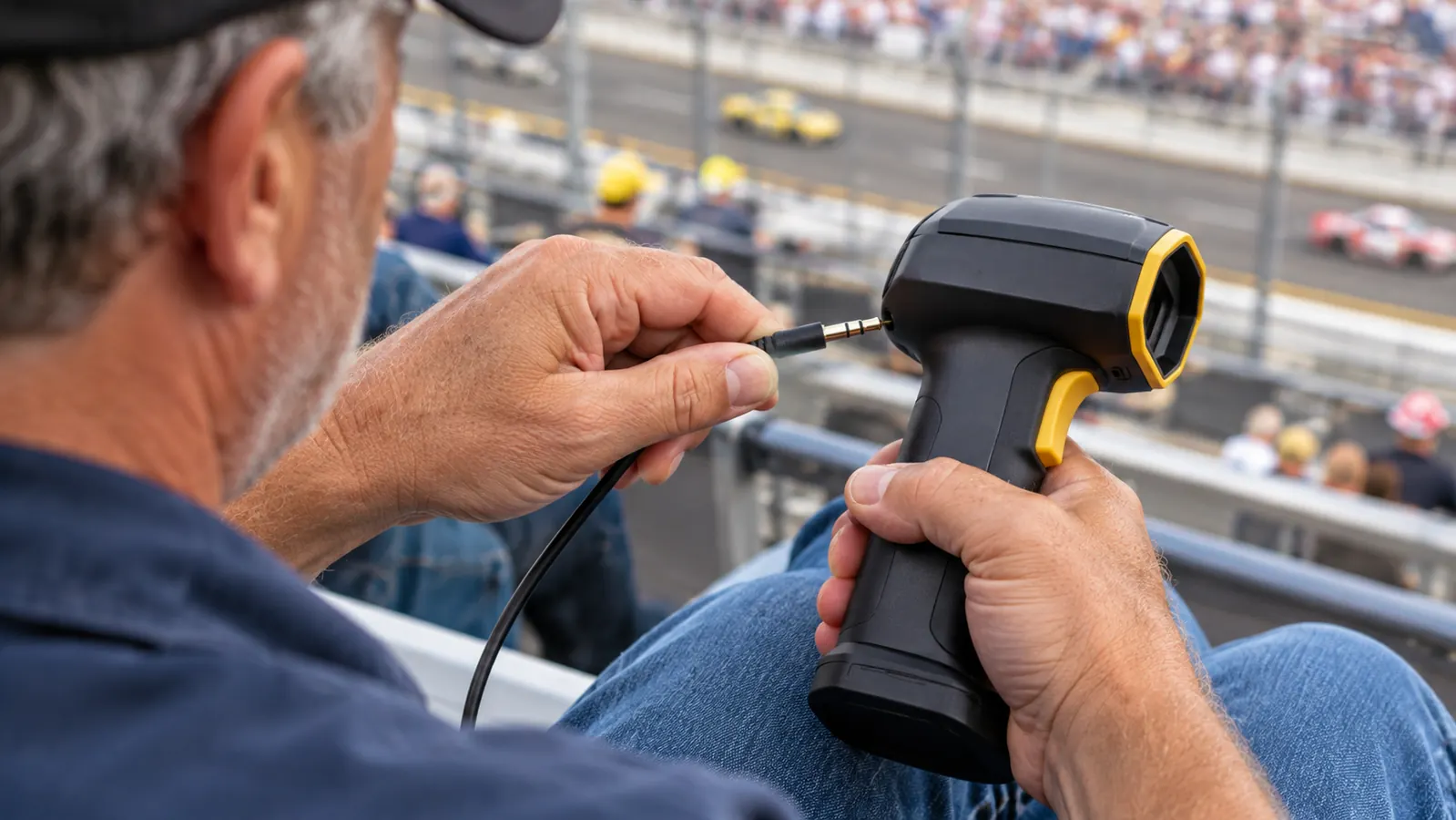
The listing shows two ways to connect: a 5-pin universal radio port and a 3.5mm input jack. I use the 3.5mm jack because that is what my scanner takes. I have not used the 5-pin port, so I cannot tell you how it works with a crew radio. If your scanner or radio uses that larger connection, check the listing against your device before you order. That is the kind of thing that is easy to get wrong when you are buying at the last minute before a race.
Three seasons in, the routine is simple. I put the cap on, put the headset on, plug in, turn the scanner on, and set the volume. I adjust the headset volume during the race when the cars come by, then turn it back down. I have never used the boom microphone to talk to anyone. It is there, and it is adjustable, but for my use it is just a part I keep angled away from my face.
What Nobody Tells You About the Fit
The first thing nobody tells you is that behind-the-head is not automatically comfortable. It is different. With an over-the-head set, the weight sits on top of your skull. With this one, the band wraps behind your head and the cushions do the work around your ears. That was better for my glasses, but it took me a couple of races to stop fiddling with it. The first time I wore it, I had the band too high and the cushions too far back. I had to slide it down and let the band settle low, near the base of my skull, before it felt right.
The second thing is that a cap changes the fit. That sounds obvious, but the order matters. I put the cap on first, then the headset, then I tuck the band under the back of the cap. If I put the headset on first and then jam the cap over it, the cushions lift and the seal breaks. The seal is what gives you the 24 NRR protection, so a sloppy fit is not just annoying. It is the difference between hearing the scanner clearly at a lower volume and cranking it up to fight the track.
The third thing is that glasses still need a little attention. The cushions go around my ears, and the arms of my glasses pass under them. I have to make sure the arms are not pinned against my head. It takes five seconds. Compared with the old headset, which had me taking my glasses off between cautions, five seconds is nothing. If you wear thick frames or a tight cap, give yourself a practice run at home before you get to the track.
The Noise Protection Is Real, With a Catch
The 24 NRR rating is the reason I trust the H41 at a Cup race. Bristol is loud in a way that is hard to describe if you have never been. Talladega is not as constant, but when the pack comes by, it is a wall of sound. With the headset on, I can hear the scanner at a volume that does not leave my ears ringing on the drive home. The sound isolation is good enough that I can tell the difference between the broadcast and the team radio without maxing out the scanner.
The catch is that you are cutting yourself off from the people around you. That is the trade. Linda has learned to tap my shoulder when she wants to say something. If I need to talk to the person next to me, I pull one cushion back or lift the headset off one ear. I do not try to carry on a conversation with both ears covered. At a race, that is fine. At a ballgame or a concert, it would be a nuisance.
The other catch is that noise protection is not the same as silence. I still hear the cars. I still feel the rumble in the grandstand. The headset lowers the volume to a manageable level. It does not turn the track into a library. If you want to hear nothing, this is not that product. If you want to hear your scanner without your ears paying for it, this is exactly that product.
I also learned to set the scanner volume first and use the headset volume as the fine adjustment. If I crank both, I get a harsh edge on the audio and I cannot tell where it is coming from. If I set the scanner at a normal level and use the headset control to bring it up when the cars come by, it sounds cleaner. That is not a scientific test. It is just what works for me.
The 24 NRR rating is why I wear the Rugged Radios H41. The behind-the-head band is why I can wear it for six hours with my cap and glasses still on.
The Boom Microphone I Never Use
The H41 comes with an adjustable dynamic noise canceling microphone. I want to be clear about this because it is part of what you are buying. I have never keyed it up at a race. I am a fan in the stands, not a spotter on the roof. I plug the headset into my scanner, listen, and that is it. If you are on a crew or you need to talk to somebody on a radio, the microphone is there. For my use, it is extra hardware near my face that I keep turned away.
That is not a complaint. It is a buying note. If you are shopping for a listen-only headset, do not pay for features you will not use and then blame the product for having them. The microphone does not get in my way once I angle it. I just would not buy this headset because of the microphone. I bought it because of the band, the 24 NRR rating, and the 3.5mm jack. Those are the parts that earn their keep for me.
Where the Rugged Radios H41 Falls Short
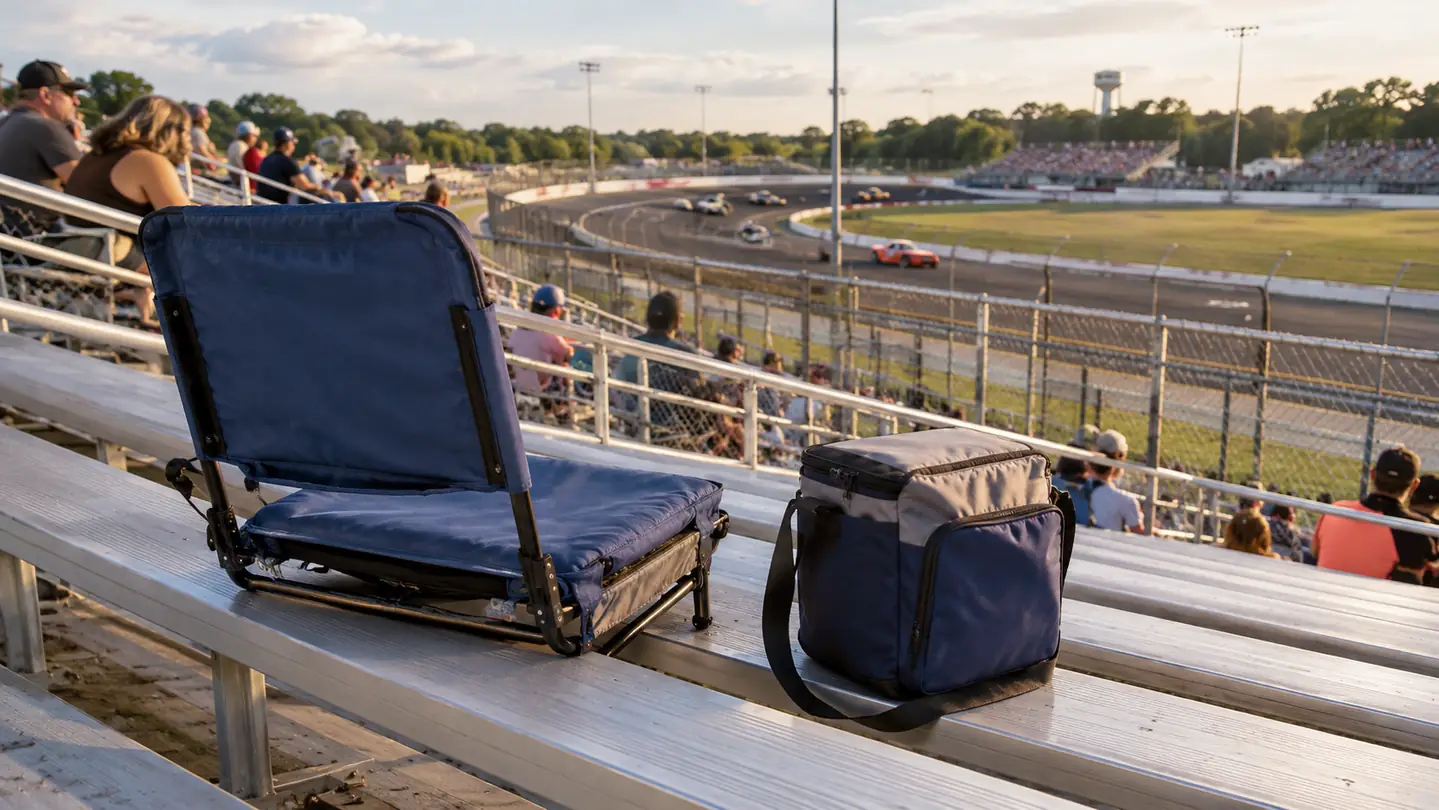
The biggest drawback is that it is a wired headset. You are tied to your scanner. That is true of most scanner headsets, and it is not a defect, but it is a fact. When I stand up to let somebody out of the row, I have to remember the cable. When I set the scanner down on the bench, the cable runs across my lap. I have learned to loop it once and keep the scanner in my lap or in the cup holder on the seat. If you want to walk around the concourse with music in your ears, this is not that product.
The second drawback is the learning curve on the fit. I already covered it, but it belongs in the shortcomings list because it is real. The first race with the H41, I spent more time adjusting it than I wanted to. By the second race, I had it down. If you are the kind of person who wants to pull a headset out of a bag and have it feel perfect in ten seconds, this one may annoy you. It rewards a little practice.
The third drawback is heat. Around-ear cushions seal out noise, and sealing out noise means trapping some warmth. On a hot afternoon at Talladega, my ears were warm by the end of the race. Not painful, not a deal breaker, just warm. I take the headset off during long cautions and let the air hit my ears. If you run hot or you hate anything touching your ears for hours, think about that before you buy.
The fourth drawback is that it cannot fix a weak scanner. A cheap scanner with a weak signal will still sound weak. The headset cannot create audio that is not there. If your scanner is the weak link, upgrade that first. The H41 is a support piece for the scanner you already own, not a replacement for it.
What I Liked
- 24 NRR rating gives real hearing protection at a loud track
- Behind-the-head band clears a cap and keeps pressure off glasses
- 3.5mm input jack works with my older handheld scanner
- Volume control lets me adjust without touching the scanner
- Around-ear cushions seal well enough to hear team radio at a lower volume
- Adjustable noise canceling microphone is there if you need to talk
Where It Falls Short
- Wired design ties you to the scanner
- Fit takes a race or two to learn
- Ears get warm on a hot afternoon
- Boom microphone is unnecessary for listen-only fans
- Not a replacement for a scanner
- Cushion seal depends on getting the band low and the cap on first
Who This Is For
This is for the fan who already owns a handheld scanner and wants to listen without pressing a headset into their glasses for six hours. It is for cap wearers. It is for people who care about hearing protection and understand that 24 NRR is a real number, not a decoration. It is for the fan who goes to one or two races a year and wants a piece of gear that will last more than a season. If that sounds like your Sunday, the Rugged Radios H41 is worth a hard look.
It is also for the fan who does not need to talk. I listen to team radio and the broadcast. I do not spot, I do not crew, and I do not need a microphone. If your race day is sitting in the grandstands with a scanner on your knee, this headset fits that day. If your race day is working a pit box, your needs are different and you should buy for that job, not for mine.
Who Should Skip It
Skip it if you do not own a scanner. The H41 is not a radio. It is a headset. Without a scanner or another audio source, you are buying a very good set of ear protection with a cable and a microphone. That is not a good use of your money. Skip it, too, if you want a wireless headset. This one is wired, and no amount of wishing changes that.
Skip it if you hate anything behind your head. The band is the whole point, but it is still a band behind your head. Some people never get used to that. Skip it if you need to talk to the people around you all afternoon. The seal that makes it work is the same seal that makes conversation a chore. And skip it if you are happy with foam earplugs and a scanner speaker. Linda is happy with earplugs. Not everybody needs a headset.
What I'd Tell a Friend at the Track
If a friend asked me at Bristol whether to buy the H41, I would ask two questions first. Do you wear glasses or a cap? Do you already have a scanner? If the answer to both is yes, I would tell them to try it. If the answer to either is no, I would tell them to fix that first. The headset is a support piece. It makes the scanner easier to hear and easier on your ears. It does not replace the scanner, and it does not make a bad seat comfortable.
I would also tell them to practice the fit at home. Put your cap on, put the headset on, plug it into the scanner, and wear it for an hour in the race room. Learn where the band wants to sit. Learn how the glasses arms feel under the cushions. By the time you get to the track, you will not be fumbling with it during the command to start engines. That is the advice I wish somebody had given me three seasons ago.
The right headset for a scanner listener, not a crew member.
If you wear glasses, wear a cap, and already carry a scanner, the Rugged Radios H41 is the one I keep in my race bag. Check the current listing and make sure the jack matches your scanner.
Amazon Check the Rugged Radios H41 on Amazon →