
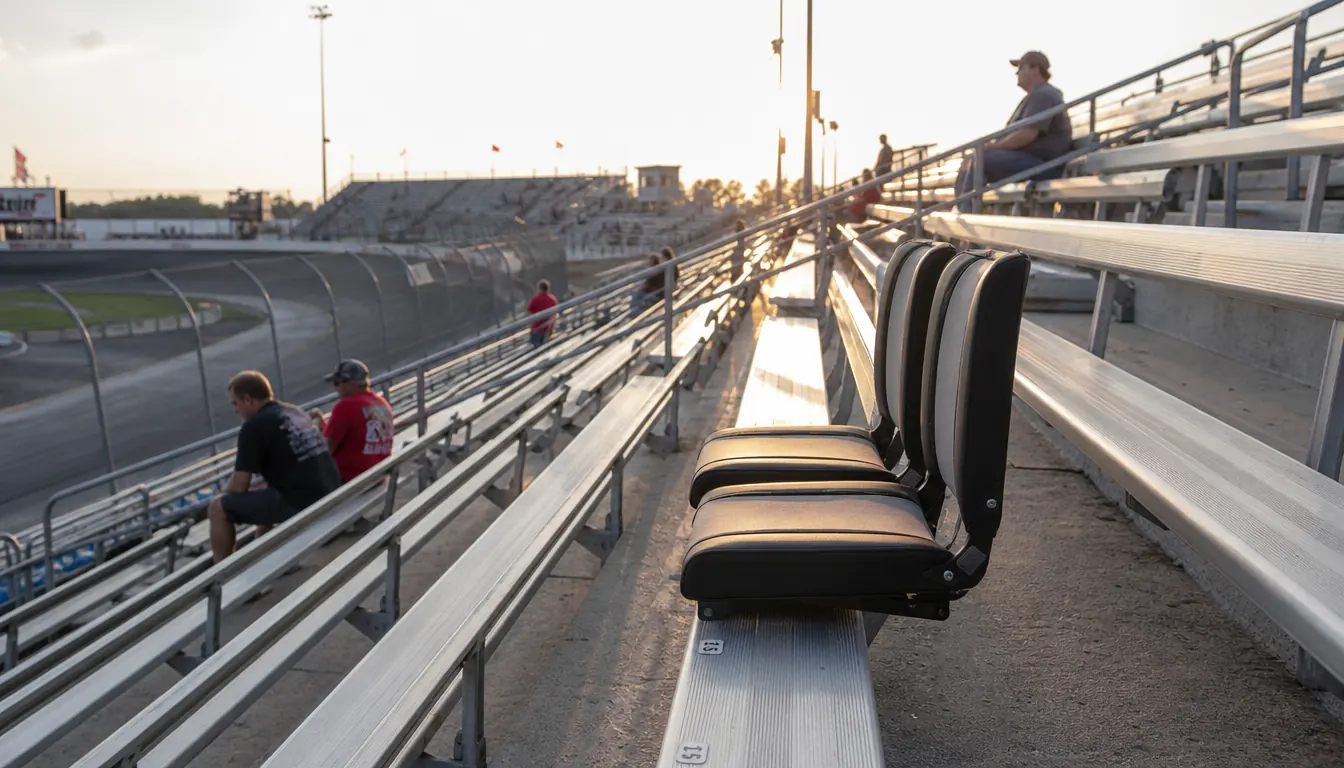
Aluminum bench seating was designed by somebody who never had to sit in it. That is the only explanation I can come up with for a slab that deep with a number stenciled on it and nothing else. No curve. No give. Nowhere to put your back. I have a bad left knee, the kind that reports on every hard surface you have ever leaned against, and for years my race weekends ended with me standing in the aisle for the last forty laps because sitting down hurt worse than standing up.
Then Linda and I bought two Everlasting Comfort stadium seats with back support before the Bristol spring race two seasons ago, and the shape of a race day changed. Not because the bench got softer. Because we quit fighting it. What follows is the routine we worked out since then, five steps, in the order we actually do them, so your Sunday in the grandstands ends with you walking to the truck instead of hobbling to it.
Two seasons, four race weekends, and a left knee that quit running the show
High-density memory foam, an adjustable backrest, and a fold-flat build with a carry strap. Ours ride in the truck bed from March to October.
Amazon Check Today's Price on Amazon →Step 1: Buy a Seat That Folds Flat and Carries Itself
My first mistake was a cushion. A flat foam pad bought at a hardware store on the drive to the track, and it did the one thing a pad can do: it turned a hard bench into a slightly less hard bench. By the second hour my lower back was doing all the work of holding me upright, and my knee took the load every time I shifted my weight. A pad is not a seat. A seat has a back, and the back is the part that matters.
What you want is something that folds flat, carries itself, and holds its shape after a couple of hours under a grown man. Ours are memory foam with an adjustable backrest, about 2.2 pounds apiece, which matters more than it sounds like it should. Linda carries hers by the built-in strap from the truck to the gate without handing it off to me, and nobody has to make two trips.
Measure your spot before you buy. Grandstand benches are not deep, and I have watched plenty of people wrestle a big square cushion into a space that did not want it. Ours are 17 inches wide and 10.5 inches deep, and they fold down to something you can slide behind the truck seat or carry on one shoulder. The storage pocket on the side holds a phone, a scanner, and the tickets I would otherwise lose. Everlasting Comfort calls it a bleacher chair, and that is exactly what it is: a chair you bring because the track does not provide one.
That first spring at Bristol I carried both seats up the ramp in one trip, one in each hand. I have not done it since. Not because it was hard, because they are light, but because a man with a knee that complains does not need to prove anything on a concrete ramp before the race even starts. Now Linda carries hers and I carry mine and we take the ramp slow. Same arrival time, and Monday morning my knee is not giving me a lecture.
Step 2: Set It Up Before You Sit Down
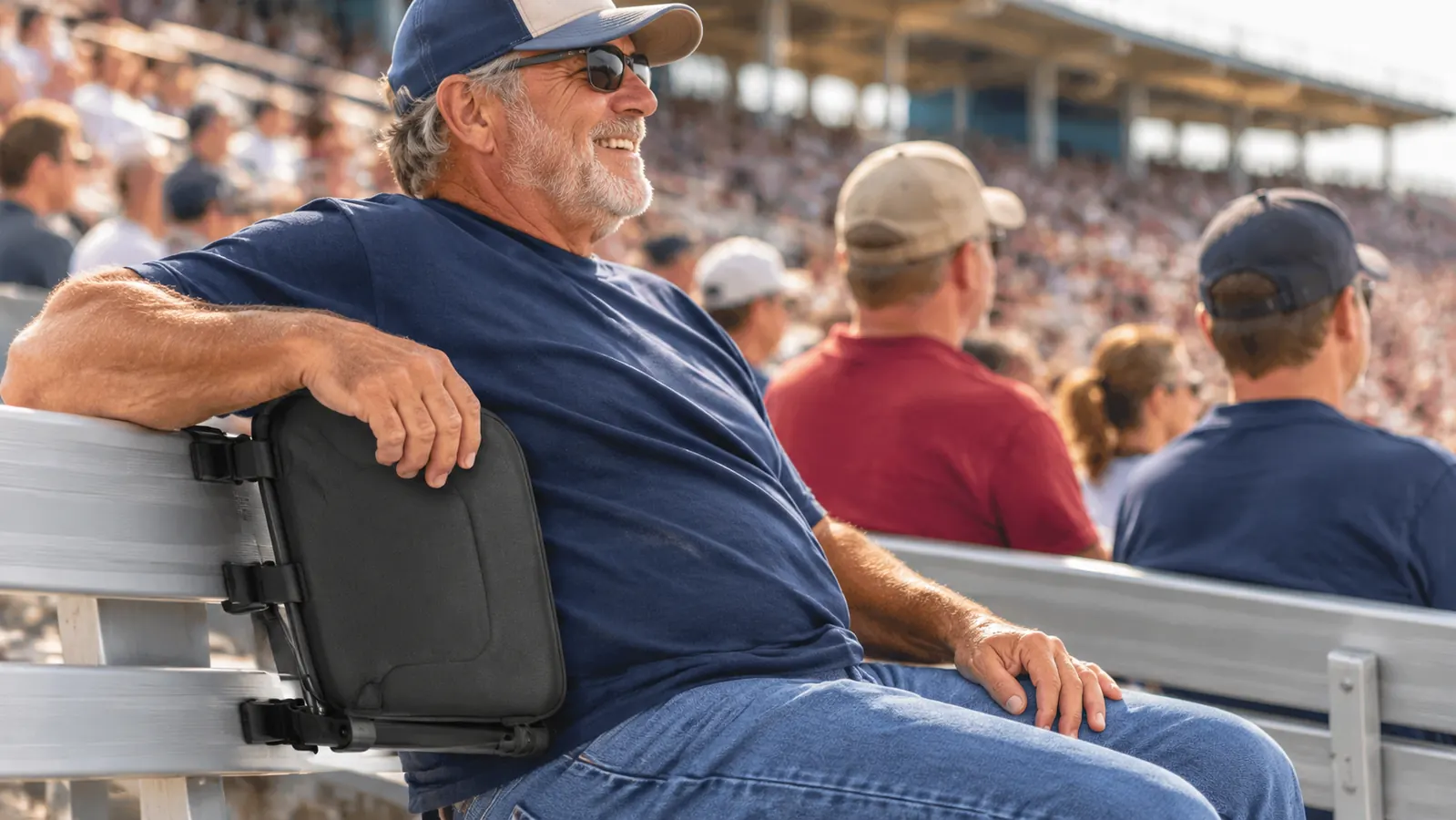
The temptation is to flop it down and drop into it. Do not. Set the backrest angle first, while there is no weight on it and both hands are free. I like mine tilted back a notch past upright, because a full day at a slight recline takes the pressure off my lower back in a way that sitting bolt upright never did. Linda keeps hers closer to straight, since she spends more of the race leaning forward to watch the big screen.
First time I tried to change the backrest angle I did it with my back already against it, and I spent a minute and a half wrestling the thing while the field came around under caution. Learned my lesson. Adjust it empty, adjust it once, and leave it. At Talladega last fall there was a fella two rows down who fiddled with his backrest half the afternoon, up and down, up and down, and I do not believe he watched a full green flag run from start to finish.
Then sit all the way back. Not perched on the front edge, which is what everybody does on bare aluminum and what wrecks your back in the first place. Feet flat on the concrete, knees around level with your hips. If your left knee is the problem, the way mine is, check that nothing is pressing behind it. The seat is armless, which I did not think I would care about and now do, because it lets me shift side to side without climbing over anything.
Clip it down so it stays. Aluminum is slick, and a seat that walks forward every time you stand up is a seat you will reposition forty times before the green flag. Mine hooks over the front edge of the bench and stays put through a whole afternoon of standing and sitting. Do the setup once, properly, and then you can forget about it until the checkered flag.
Step 3: Get In Early and Claim Your Footprint
Grandstand rows were not built for adults with luggage. Get through the gate early, find your row while it is still mostly empty, and set up before the people on either side of you arrive. It is easier on you and it is just being decent to them. I have watched a man try to wedge a seat into a full row between two seated fans, and it went about how you would expect.
We leave Hamilton early enough to be through the gate at Bristol the minute they open it, which is earlier than feels reasonable and worth every minute of it. Two hours before the command to start engines the row is half empty and you can set up like you are moving into a house. Two hours after that you are balancing a folded seat on your hip in a crowd that is not in the mood to wait for you. Same seat. Very different afternoon.
Once you are in, decide where everything lives. Cooler under your feet or under the bench in front. Seat back against the bench. Phone, scanner, and tickets in the pocket so you are not digging through three layers every time somebody needs something. Keep the aisle clear. A race is three hours before you count the walk in and the walk out, and a row that stands up every four minutes for the rest of the afternoon turns into a bad day for twelve people.
Say hello to the folks around you. That has nothing to do with comfort and everything to do with the day. The man next to us at Talladega has been in the same section for years. I do not know his last name. By the end of the race we are passing snacks back and forth and somebody is holding somebody else's seat while they go get a hot dog. You give up a little personal space and you get a much better afternoon.
Two seasons, four race weekends, roughly nine hours a day in the grandstands, and my knee stopped deciding when we go home.
Step 4: Pack for Heat, Noise, and Concrete
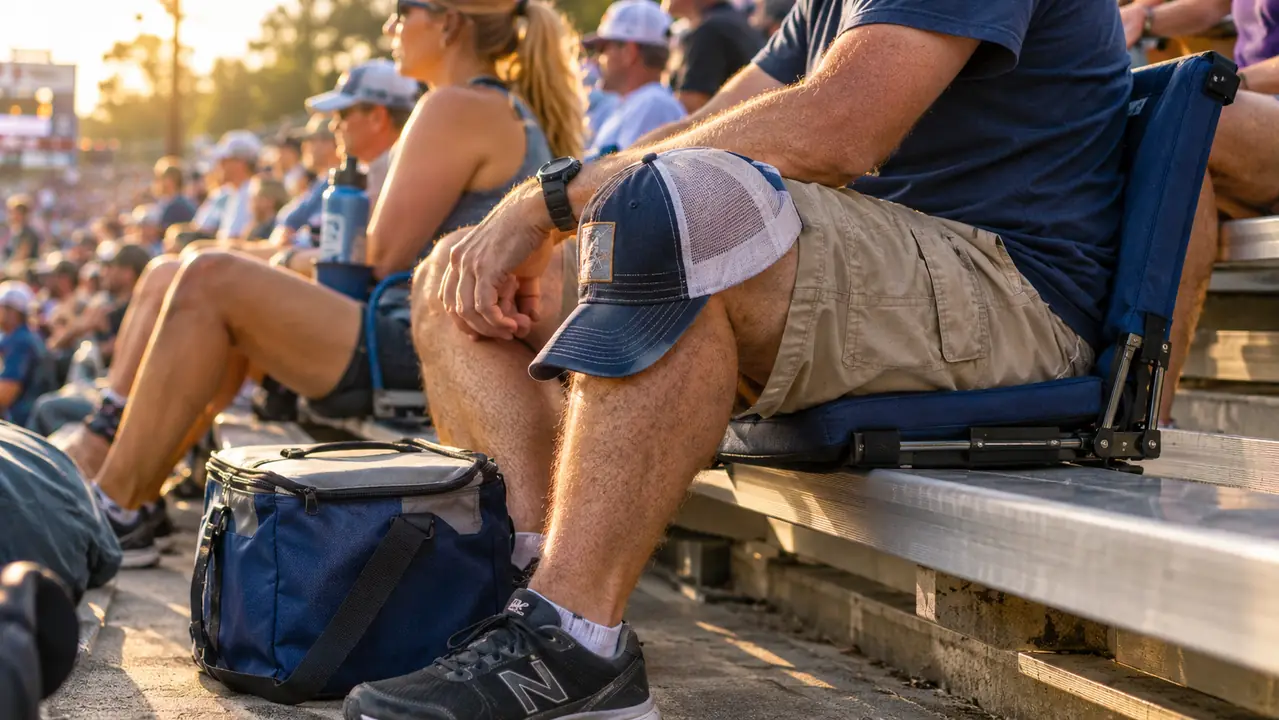
The stands get hot in a way that surprises people who have only watched on television. Aluminum radiates back at you and concrete holds whatever the sun gave it. We carry an Under Armour Sideline Pro soft cooler, two seasons old now, which holds twelve cans plus ice and has a quick-access lid I can open without standing up. It has fence hooks too, which we have never used at a track. Check your own track's posted cooler policy before you pack, because every track sets its own rules and they change.
Talladega in the fall is not supposed to be hot and some years it is anyway. The aluminum soaks up the sun all morning and then hands it back up through your legs all afternoon, and the concrete does the same thing slower. That is the day a seat earns its place, because bare aluminum with the sun on it is not a surface a grown man should sit on for six hours. We started bringing a second bag of ice after the first year, and it is gone before the second stage.
For noise I wear a Rugged Radios H41 behind-the-head headset. The band goes behind my head instead of over the top, so my cap still fits, and it gives me 24 NRR of hearing protection with a volume control I can turn down when the field single-files past. I plug it into the handheld scanner I have had for years through the 3.5mm jack and listen to team radio and the broadcast. I have never once used the boom microphone to talk to anybody. Linda wears foam earplugs and is perfectly happy.
And wear a hat. My son gave me a FirstCos Talladega Nights trucker cap two years ago as a joke about my Talladega trips. It is a novelty movie cap, not team merchandise, and I say that plainly because somebody always asks. Cotton, adjustable strap, and it gets a laugh in the grandstand every single fall. Sun on the back of your neck for six hours is not a small thing.
Step 5: Reset at the Halfway Point
Somewhere around the second stage, stand up. Not because you have to, because you should. Walk the concourse, get the blood moving, come back and reseat yourself with the backrest where it belongs. The mistake people make is staying planted until something hurts, and by then a five minute walk is not going to fix it.
When you sit back down, take thirty seconds and redo the morning. Backrest angle, feet flat, cooler squared away. Same setup, done again, and it buys you the whole second half. I keep a rag in the truck for the ride home. Polyester and memory foam wipe clean, which matters after a day of spilled soda and track dust.
One more thing about that walk. It is where the day happens. Linda and I have had some of our better afternoons standing in line at a souvenir trailer or poking through a diecast table. Six 1:24 display cases on the shelf in my race room came from days like that. If you never get up, you never see any of it.
What Else Helps
Two cheap items. A small towel to sit on when it rains before the race, because memory foam holds water longer than you would like, and a plastic bag to drop the seats into if they get wet on the way home. Keep both in the truck. Also bring a spare pair of foam earplugs. Somebody around you always forgot theirs, and the goodwill costs you about a dollar.
And be honest about how many hours you are signing up for. A NASCAR Sunday is not two hours. Gates, practice, the walk in, the race, the walk out. If your back and your knee already have opinions at home, a seat with a real back and memory foam under you is not a luxury item. The Everlasting Comfort seats are the reason we still go twice a year instead of once, and I would rather spend the money on that than on another cap I do not need.
Two of these live in my truck from March to October. That is the whole review.
Memory foam cushion, adjustable backrest, folds flat at about 2.2 pounds with a built-in carry strap. It hooks onto aluminum benches, has a storage pocket, and wipes clean after a hot day.
Amazon Check Today's Price on Amazon →