
A diecast car on an open shelf is a small tragedy on a slow schedule. Nothing dramatic happens to it. Nobody knocks it off. It just sits there gathering a gray film of dust for two or three years, and then one afternoon you hold it up to the light and the paint looks tired, the windshield looks cloudy, and you cannot remember whether it looked like that the day you bought it.
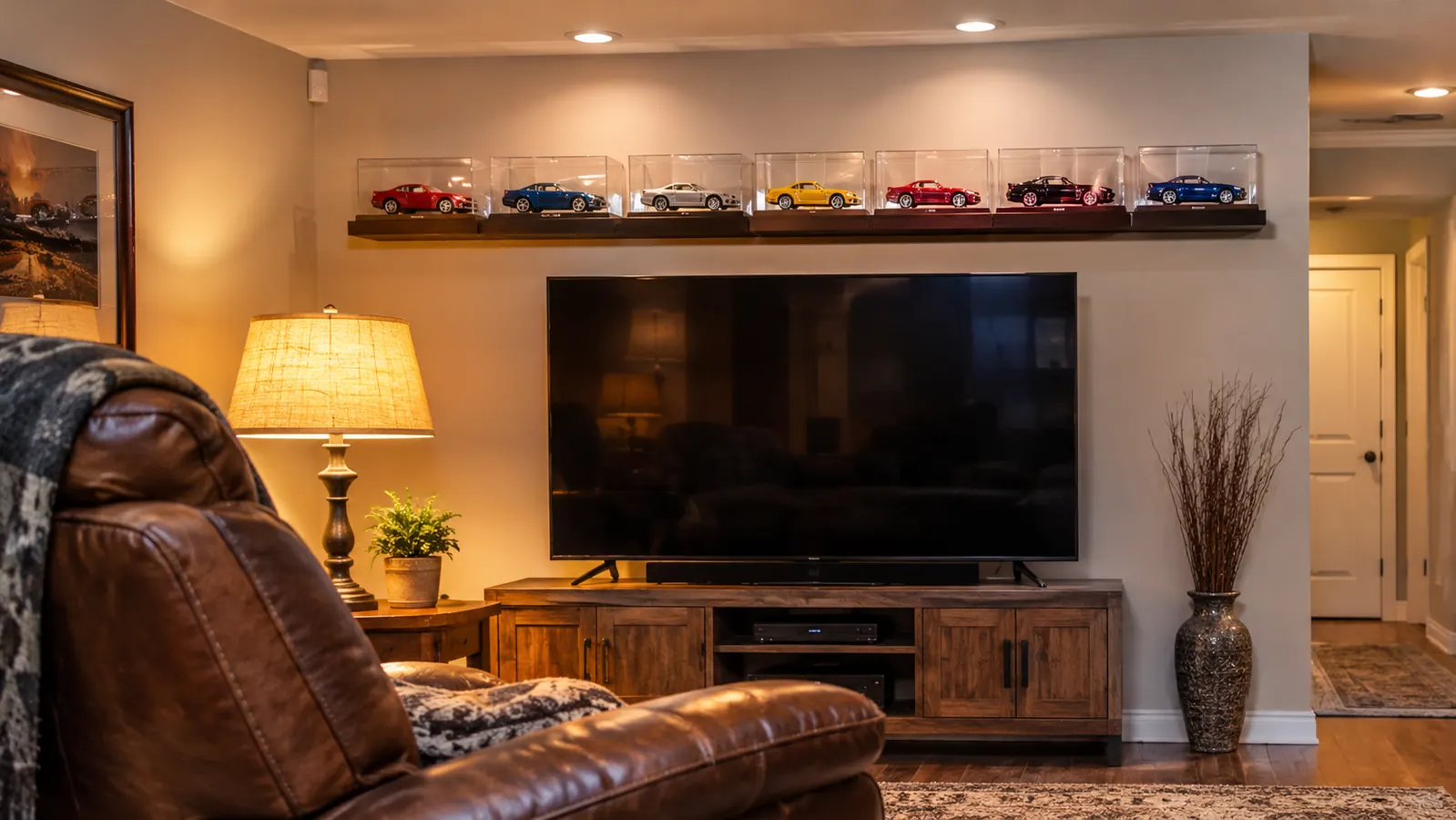
I keep six 1:24 scale cars on a shelf in my basement race room, and every one of them sits inside a BCW 1:24 display case, the kind with a clear acrylic cover over a base. I bought the first case about two years ago after a whole season of dusting cars with a soft paint brush and still missing the spot behind the rear spoiler. The other five came along as the collection grew. What follows is the order I would do it in if I were starting with an empty shelf, which is close to the order I actually did it in, minus a couple of detours I would rather you skip.
One car, one case, and the dusting stops
The BCW case is sized for a single 1:24 car at 10.25 by 3.75 by 3.5 inches, so six of them turn a dusty shelf into a row you can actually see.
Amazon Check Today's Price on Amazon →Step 1: Measure the shelf before you buy a single case
My first mistake was buying cases one at a time and figuring out the shelf later. Do it the other way around. The BCW case is listed at 10.25 inches long, 3.75 inches wide and 3.5 inches high. Six of them butted together is about 62 inches, and you should not butt them together. Plan on 66 to 68 inches of shelf for a row of six, which leaves a finger width between cases and a little air at both ends.
That 62 inch number is the reason my first shelf was wrong. I had a six foot board, which is 72 inches, and I assumed that meant room to spare. Between the two wall brackets and the bit of the board I wanted showing past each end, I had closer to 66 inches of usable run, and the front row of cases ended up tight against the left bracket with a bare gap on the right. Nothing was broken. It just never looked right, and I looked at that gap for a year before I fixed it.
Depth matters more than people expect. The case is 3.75 inches deep, so a standard shelf board leaves you room to push the row back from the edge. Mine sits about an inch and a half in from the front. That means a sleeve, a thrown remote or a grandkid's elbow hits the shelf before it ever reaches a car.
Then check the height against where you actually sit. Lower yourself into the recliner, look at the wall, and pick the line where the shelf should go. In my race room the shelf sits just above the top of the television, which puts the cars at eye level when I am leaned back. A basement gets crowded with a TV, a recliner and whatever else has drifted down there over the years, so settle the footprint before anything else.
One more thing worth deciding early: one long shelf or two shorter ones. A single run of six cases reads as a collection. Two short shelves read as two collections, and you end up splitting the cars by which shelf happened to have room, which is no way to arrange anything you care about.
Step 2: Sort the collection before you display any of it
The next mistake was trying to show every car I owned at once. Some came from souvenir trailers at Bristol and Talladega. A couple were birthday gifts from my kids. And one or two I bought because the paint scheme looked good under the lights at the track and I had no real attachment to them. Six cases means six slots. That is the discipline, and it is also what makes a shelf worth walking over to.
Pull everything out of the boxes and bins and spread it on the kitchen table. Then sort into three piles: races you actually attended, cars that mean something because of who gave them to you, and everything else. The third pile goes back in the bin. Not forever. Just until you rotate.
Be honest in that sorting. The car you keep because it was cheap is the car taking the slot the good one wanted. I pulled three off my shelf in the first pass and have not missed any of them since. One of them had been sitting on the shelf for so long that the tape holding its box closed had gone brittle and left a mark on the roof I could not shift.
Rotating is the part I have come to like. Before the spring race at Bristol I pull two cars off the shelf and swap in two from the bin. The shelf feels new for free, and the cars coming off go back into their boxes where they stay clean until their turn. My wife Linda has stopped asking why there are cars on the kitchen table every March.
Step 3: Give every car its own case, not a shared one
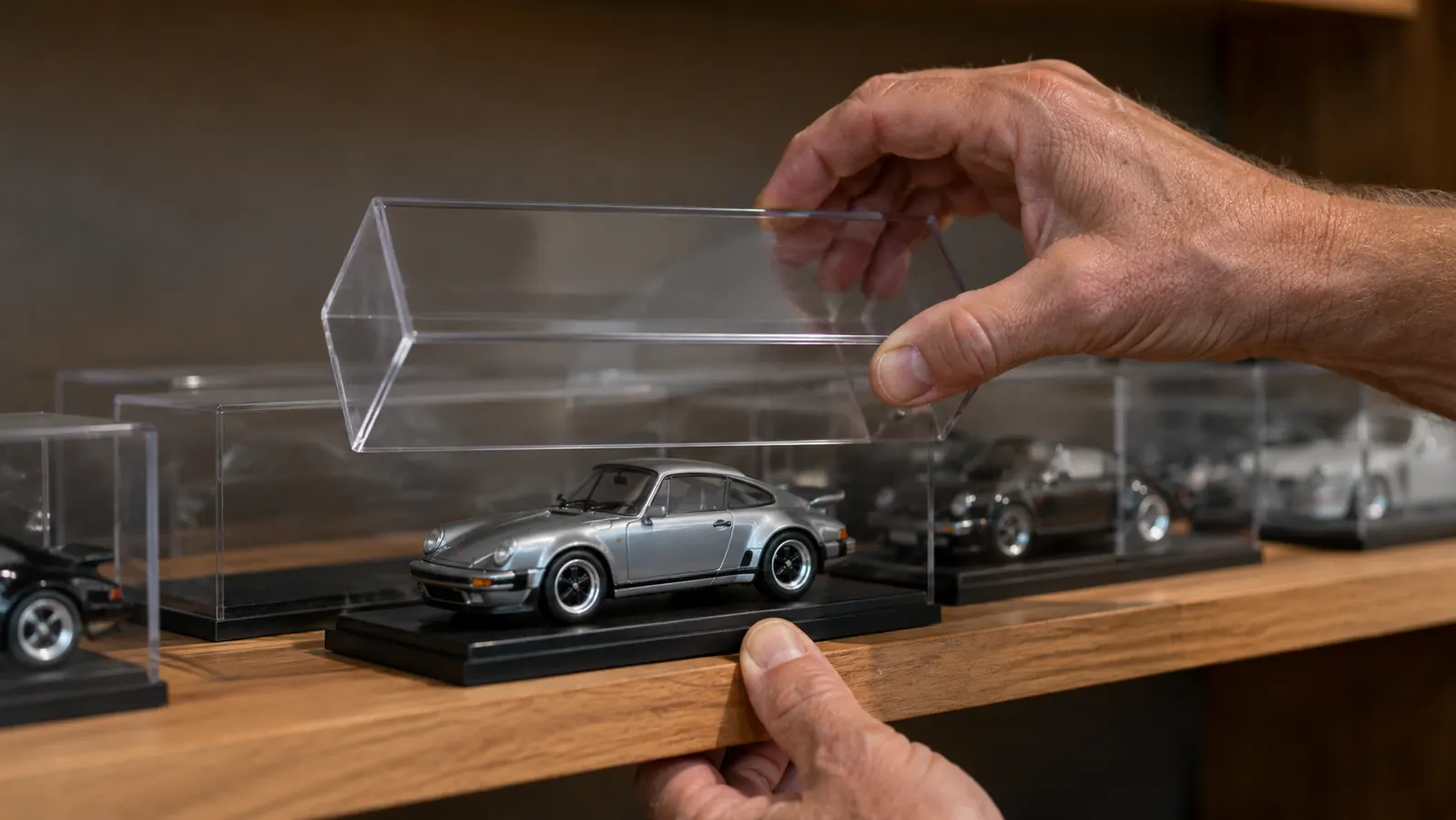
A case holds one car. That is the whole idea and it is worth paying attention to. Multi-car cabinets and open shelves push cars close together, and the first things to get bent are mirrors, spoilers and the little details along the roofline. One car per case means one car per space and nothing touching anything else.
Dust is what pushed me over the edge. I used to keep a soft brush by the shelf and dust every couple of weeks, and I always missed behind the rear spoiler and around the base of the windshield. You can feel yourself pressing harder than you want to on a decal. Since the BCW cases went in, I have not put a brush on a car. The acrylic cover sits over the base and lifts off when I want a closer look at something.
The rigid cover matters more than it sounds. A shelf in a race room is at elbow height when somebody walks past with a drink or a plate of food. The cover takes that bump and the car does not. After two years and a house full of company on race weekends, all six of mine are still sitting square on their bases.
Keep the covers on, too. It is tempting to leave a car uncovered for a week because you like looking at it, and that week turns into a whole season. Dust comes back faster in a basement than you would guess, with a furnace and a dryer both pushing air around down there. I tested that theory by leaving one car bare for a month while the case was off being wiped down. It came back gritty across the hood, and the case went right back on.
Step 4: Space the row and set the height
Six cases at 3.75 inches wide is 22.5 inches of case, and with gaps you are looking at roughly two feet of shelf. That leaves room on the same run for a ticket stub from a race, a program, or a scan sheet, which is the sort of thing that makes a race room look lived in instead of ordered out of a catalog.
Get the row at eye level or just above it. Too low and you spend the rest of your life looking at the tops of the roofs. Too high and all you see is the rear deck lid. I hung a shelf about eight inches too high the first time around and moved it the following weekend, which is a lesson I could have skipped.
That Saturday is worth describing so you can avoid it. I hung the brackets, loaded all six cars, sat down in the recliner, and spent twenty minutes looking at a line of roof panels. Linda walked in, said the cars looked like they were hiding, and she was right. I pulled the whole thing down, patched four screw holes, and moved the shelf down to sit just above the television. The patch is still faintly visible if the lamp is on. Nobody notices it but me.
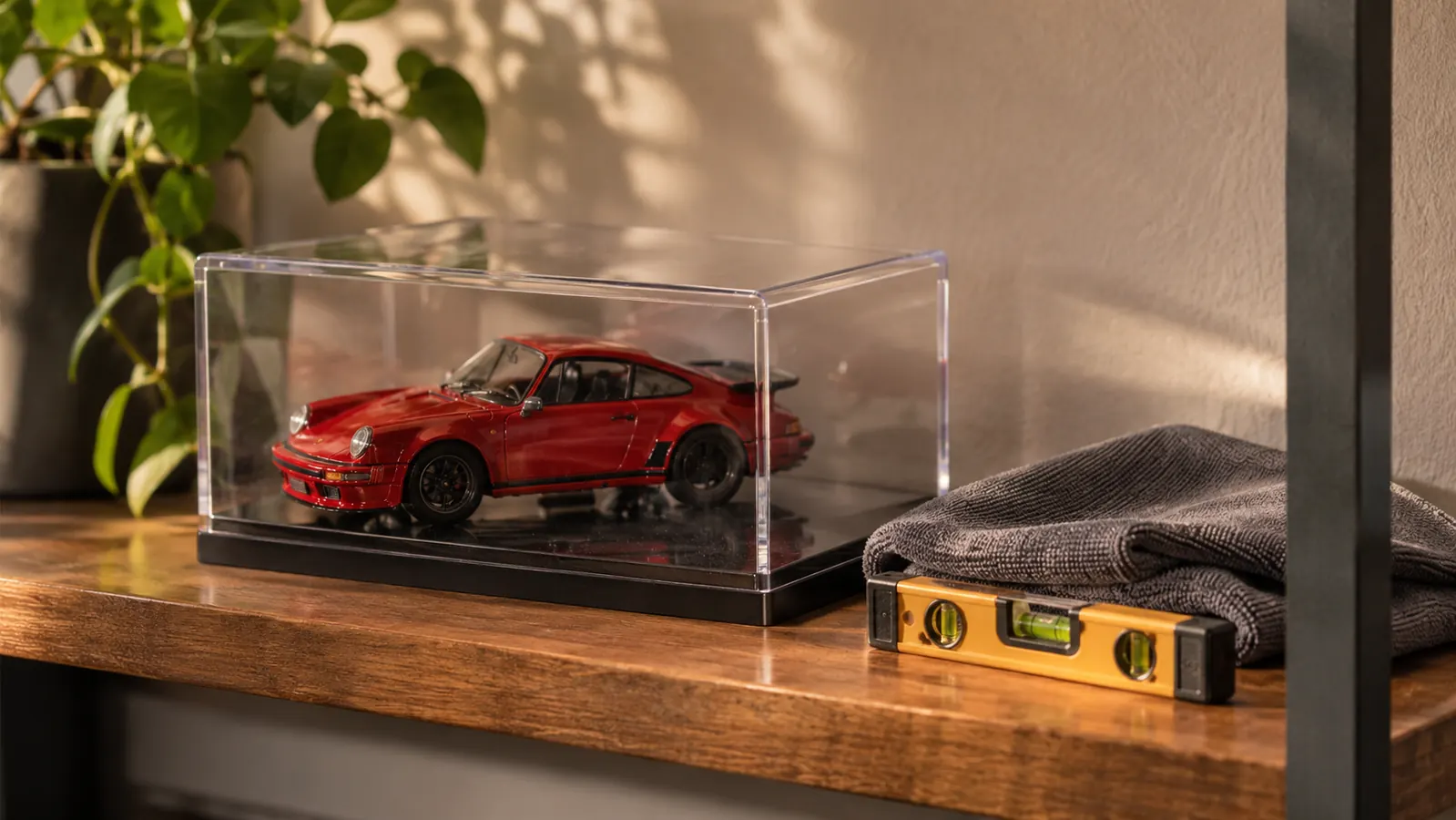
Level the shelf before the cases go on it. The cases are rectangular, so a level shelf gives you a straight line, and a shelf with a sag in the middle gives you a row that looks like it has been out all night. A small level and ten minutes on the brackets is all it takes.
Do not stack cases or stand one on its end to make room. The base is made to sit flat and the whole thing is built to hold one car in one position, so a case on its side is a car leaning against acrylic. Space is what a display needs. A shorter row always looks better than a crowded one.
Step 5: Light the room, not the cars
Direct sun is the enemy of anything on display. A basement usually saves you from that, except for the one window somebody insisted on. If your shelf catches a slice of afternoon sun, move the shelf or put a shade on the window. Paint and decals do not need any help fading.
For the light you do want, throw it at the wall behind and above the shelf rather than straight down onto the covers. A lamp behind the recliner is enough to see the cars in the evening, and it puts nothing harsh on the acrylic. Light raking across a cover at a low angle is what makes clear plastic look scratched when it is perfectly fine.
I learned that one the expensive way by almost replacing a case that had nothing wrong with it. The case caught the reading lamp at a shallow angle and showed a long bright streak across the front. I had the order form open before I thought to wipe it with a microfiber cloth, and the streak came off in one pass. It was a fingerprint the whole time. Now the cloth lives in the drawer next to the recliner.
If you have a ceiling fixture directly over the shelf, put it on a dimmer or swap the bulb for something warmer. Bright light straight down turns every fingerprint on a cover into a headline.
And keep the room dark when you are not down there. A race room with the lights off six days a week keeps the cars looking the way they did on day one, which is the entire point of putting them behind something.
What Else Helps
Keep a microfiber cloth in the room for the outside of the covers, and only the outside. Wiping fingerprints off acrylic is harmless. Wiping the car itself is how small trim pieces disappear into a carpet.
Label each base. A strip of tape or a small card tucked under the front edge with the race and the year means you never stand there squinting, trying to remember which Talladega trip that car came from.
Tug the shelf before you load it. Nothing up there is heavy, but a shelf that was hung for a paperback and a picture frame still deserves a pull. Keep the original boxes in a bin in a closet, and if the collection ever outgrows the wall, the BCW cases pack into a tote far more easily than loose cars do.
Leave the shelf alone for a week before you decide it is wrong. A neat row looks strange at first because you are used to a cluttered one. Give it a weekend of race coverage before you move a single case.
Six cases at 3.75 inches wide is 22.5 inches of shelf. Two feet is the difference between a display and a pile.
Start with the six cars you would actually miss
One case per car, spaced along a level shelf at eye level, and the race room stops looking like a storage bin and starts looking like a room. That is the whole method.
Amazon Check Today's Price on Amazon →