
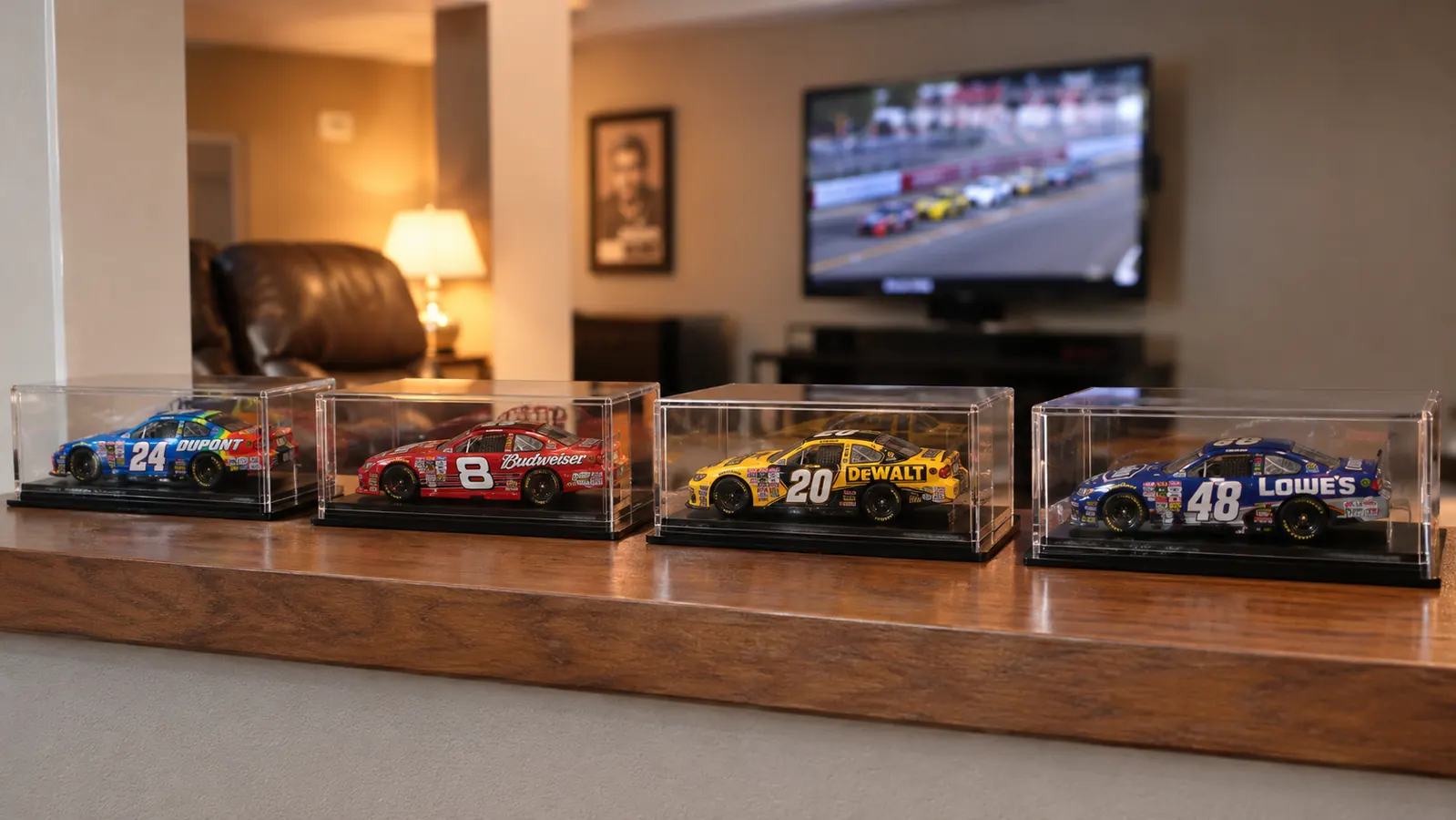
Short answer: if your cars live on a shelf and you add one or two a year, buy the BCW cases one at a time. If you have a dozen cars stacked in their boxes in a closet and an empty stretch of wall in the room where you watch races, buy the wall cabinet. Those are two different jobs, and the mistake is buying for the collection you might have someday instead of the one sitting in front of you right now.
I'll show my hand before I compare anything. I own six of the BCW 1:24 display cases, bought one at a time over about two years, sitting on a shelf in my basement race room here in Hamilton, Ohio. Each one holds a single 1:24 car. Dust is what started me on them. I had cars on an open shelf and after a couple of seasons they looked like they'd been parked at the back of a garage since the Carter administration. So I am not neutral. But I have also stood in front of a friend's wall cabinet holding a dozen cars behind glass and felt that pull, and I'd be lying if I said I hadn't thought about one since.
Below is the comparison laid out row by row, with the wins going where they actually go and not where I'd prefer them to go. Then I'll tell you which one I'd buy in your situation, including the situation where the answer is not mine.
| BCW 1:24 Display Case | Wall Cabinet for 1:24 Cars | |
|---|---|---|
| How many cars it holds | One car per case | A dozen or more per cabinet |
| What it needs from your house | A shelf or any flat surface. No drilling. | Wall space, a stud finder, and a free afternoon |
| Dust | A clear acrylic cover over each car, nothing opened but the one you're handling | Doors keep most of it out, but every opening lets a little in across the whole collection |
| Starting from zero | Buy one case for the one car you own | One purchase covers cars you don't have yet |
| Growing the collection | Add a case per car, whenever you buy the car | The next ten cars disappear into it |
| Getting a car out to look at it | Lift the cover, set it down, done | Open a door, reach past two rows, close it again |
| Protection for one prized car | Sealed on its own base, nothing else touching it | Shared space, and the neighbors get closer as you add cars |
| Presence in a room | Six small cases on a shelf read as six small things on a shelf | One unit reads as furniture, and glass reads as a display |
| Taking a car somewhere | Carry the case with the car still inside it | Nothing moves without emptying it first |
| Best for | One car at a time, one shelf, a car you keep looking at | A big collection that needs a home on a wall |
Where the BCW Case Wins
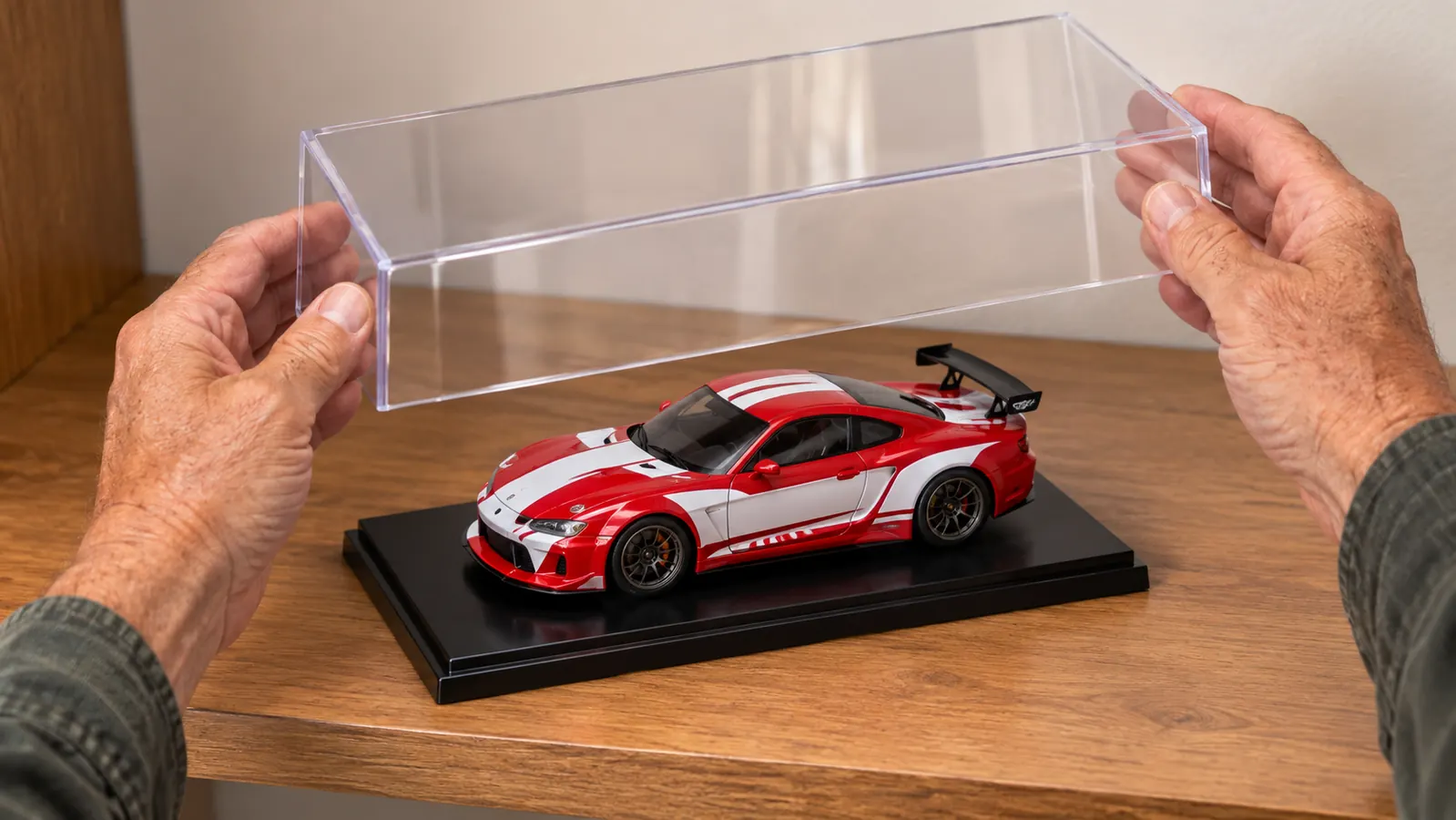
Start with what a case actually is, because the size tells you most of the story. The whole piece measures 10.25 inches long, 3.75 inches wide and 3.5 inches tall, with the cover itself at 9.75 by 3.5 by 2.375. That is one car, one box, one air space. It sounds fussy until you've dealt with dust on an open shelf of models. A cabinet holds a dozen cars in a shared space, so every time you open the door to add one or pull one out, everything inside gets a fresh visit from whatever is floating around the room. A case comes off, one car comes up, the cover goes back down. Nothing else is exposed for more than a few seconds.
I learned that the slow way. The first car I ever put out, a track souvenir from a Bristol trip years back, sat bare on a shelf for two seasons. When I finally picked it up to look at it, the roof felt like felt. I tried a microfiber cloth, and that took the loose layer off but left a film in the corners around the rear spoiler that I never fully got out. Then I tried rinsing it under the tap, which was a mistake I will only make once, because a drop got into the axle and the wheels have never rolled quite right since. That car now lives in the first BCW case I ever bought, and it is the reason I bought the other five.
The other thing the BCW case does better is start where you actually are. You buy the case because you bought the car. No drilling, no stud finder, no leveling, no measuring the wall twice and still ending up crooked. It's a tabletop piece, so it goes on a shelf, a desk, a dresser, the top of a bookcase. When I moved the race room furniture around last winter, the cases moved in one trip, one under each arm. A cabinet is a piece of furniture you install. A case is a thing you pick up. If you rent, or you're in an apartment, or you just don't want holes in a wall you'll have to patch later, that difference is the whole decision right there.
Where a Wall Cabinet Wins
Now the honest part. If you have twenty-five cars in shoeboxes, my method is a five-year project. A cabinet absorbs the entire collection in one afternoon. That is a real advantage and it isn't a small one. The same goes for growth. The next ten cars you buy will need ten more cases, and each one has to be ordered, unpacked and placed, while a cabinet simply swallows them. If your collecting runs faster than a car every few months, cases turn into a chore and the cabinet turns into the sane answer. That's true even for somebody like me who likes the cases.
The cabinet also wins on presence, which collectors pretend not to care about and absolutely do. Six small cases on a shelf read as six small things on a shelf. A cabinet reads as a display. Glass doors, a whole row of cars behind them, one unit doing the work of furniture. If your race room is also the room where you sit with friends on a Sunday and watch the race, that matters more than any spec sheet will ever tell you. It's also the only option left when the shelf space is gone and the wall is the last place you have to put anything.
The car sitting on your desk right now already has a case sized for it
One car, one clear cover, 10.25 inches of shelf. No drilling, no stud finder, nothing to install.
Amazon Check Today's Price on Amazon →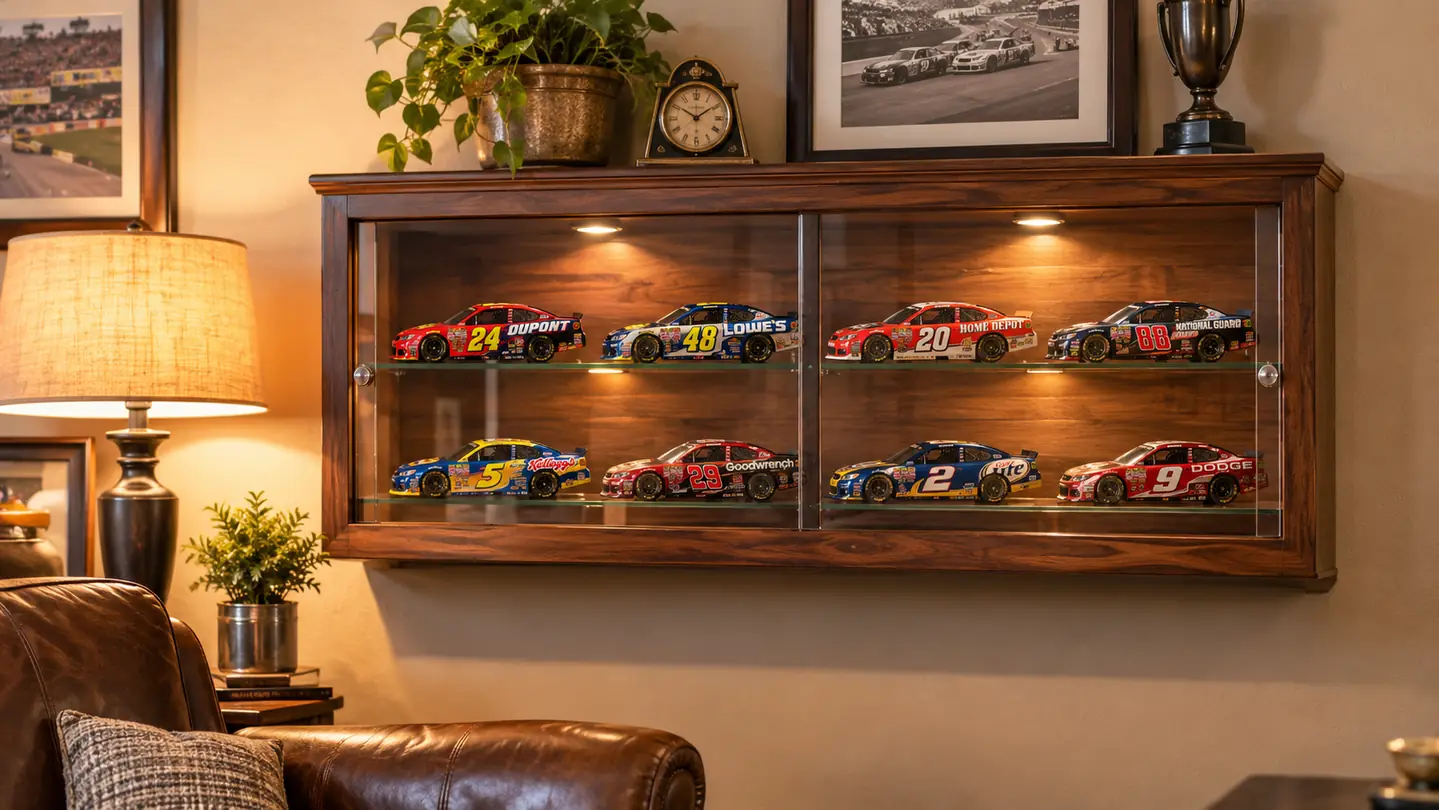
What Six Cases Actually Look Like After Two Years
Two years in, mine look pretty much the way they did the day they arrived, with one caveat. The cars inside are as clean as the day I shelved them, which was the entire point. The outsides collect dust like anything else, and I run a cloth over them every few weeks, which takes about a minute for all six. Acrylic will scratch if you treat it like a toolbox, so I lift the covers straight up and set them down rather than sliding them around. And the shelf needs at least 10.25 inches of depth per case, which is worth measuring before you buy, because a shallow bookcase won't take them front to back.
I measured the shelf wrong the first time, so you don't have to. My old bookcase was eleven inches deep on the outside, which sounded like plenty until I got the first case home and the back edge hung over the trim by half an inch. It sat there looking like it was about to tip for a month before I gave up and moved the whole row to a deeper shelf on the other side of the room. I took a tape to the store the second time and put a pencil mark on the wall where the new shelf would go, then checked that the mark was clear of the TV and the recliner's swing before I drilled anything. Boring work, but it is the difference between a display and a shelf that bugs you every time you look at it.
The thing I'd tell you to think about is the look. Six single cases lined up are tidy, but they are six separate objects. If you have them three deep on a shelf with a cooler and a stack of racing programs next to them, it reads as storage rather than a display. Mine are spaced with a couple of inches between them and nothing else on that shelf, and that spacing is the difference between a row of cases and a pile of stuff. If you can't give them their own shelf, the cabinet argument gets stronger, and I'd say that to your face.
One more practical note from having moved these around. The cover lifts off cleanly and the car sits on the base, so carrying a case across the room or out to the truck is a two-second job and the model never gets touched by a hand. I have taken one to a friend's place to show him a car he'd been asking about, rode in the front seat with it the whole way, and it came back with nothing on it. Do that with a cabinet and you're carrying a car loose in a towel.
Two years, six cases, and I have not dusted a single car since. I wipe the outsides in about a minute and that is the whole maintenance schedule.
Who Should Buy Which
Buy the cases if you have a shelf and a modest collection that grows slowly. Buy them if there is one car you actually care about, the one you picked up at the track on a Sunday you still remember, and you want it where you can see it instead of where it's collecting grit. Buy them if you rent, if you don't want to drill, or if you like the idea of picking a car up and carrying it to a friend's house. And buy them if you'd rather spend a little at a time than one larger amount all at once, which is how I ended up with six of them without ever feeling it.
Here's the concrete way I'd frame it. Count the cars you own right now, not the ones you plan to. If that number is under eight and they're already out on a shelf, cases are the answer and you'll be finished in an afternoon. If it's over fifteen and half of them are still in the box they shipped in, you're not solving a dust problem, you're solving a storage problem, and a cabinet does that in one piece. Between eight and fifteen is the gray zone, and that's where I'd buy a case for the two or three cars I actually stop and look at, and put the rest wherever they fit until the wall starts calling.
Buy the cabinet if the cars outnumber the shelf. If you're at fifteen or twenty and they're living in boxes in a closet, the cabinet is the honest answer even though it's the one I don't own. Buy it if you have wall space in the room and no shelf space left, if you want the collection behind glass where company can see it without handling anything, and if you're the type who adds a car every month and doesn't want to think about it again. Buy it, in short, when the collection has gotten bigger than the piece of furniture you started with.
Most people I know end up with both eventually. A cabinet for the bulk of it and a case or two out front for the cars they actually stop and look at. That's not indecision, that's just how a collection behaves over ten years. Start with whichever problem is bothering you today. If it's dust on a car you love, that's a case. If it's twelve cars in a closet and a wall doing nothing, that's a cabinet. Neither one is a mistake, and the only wrong move is buying for a collection you don't have yet.
Start with the one car you'd rescue from the house on fire
It holds a single 1:24 car, sits on any shelf, and takes the dust problem off the table permanently.
Amazon See the BCW 1:24 Display Case on Amazon →