
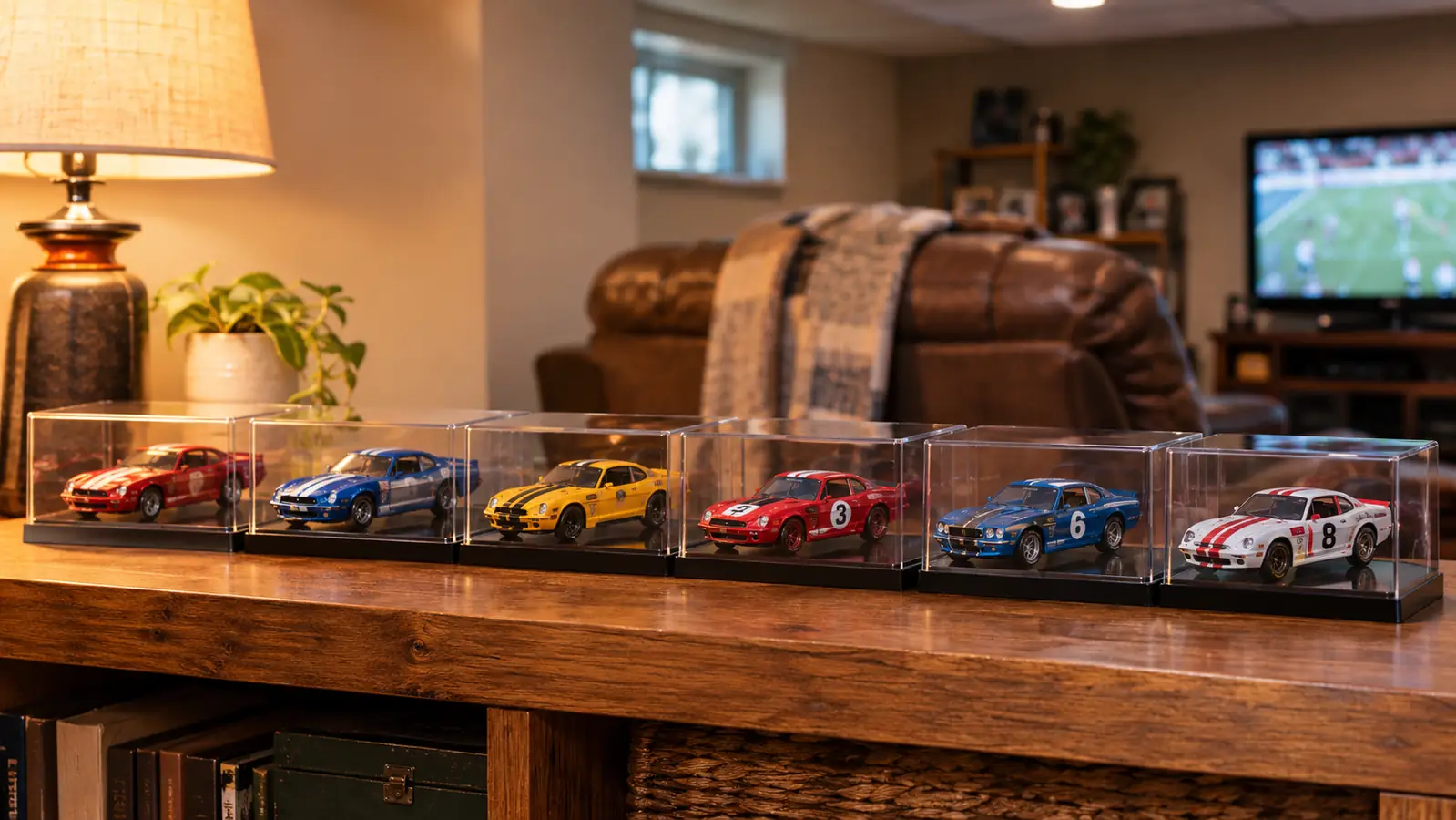
Six of these cases sit on a shelf in my basement race room and every one of them is a BCW. That tells you how the story ends. What it does not tell you is the part I had to learn the slow way, which is that the case is a good product with a couple of sharp edges, and that a fair number of the complaints you will read in the Amazon reviews are really about putting the wrong car inside it. I bought my first one two years ago because a 1:24 car I picked up at a souvenir stand was going gray on the roof from dust. I have bought five more since. Here is the version of this review I wish somebody had handed me before the first one.
A note on what this is not. It is not a piece that talks you into buying six of anything. One case holds one car, so the math runs away from you fast if you have a shelf full of them. What follows is the fit numbers, the handling quirks, the two things that genuinely annoy me, and the places where the case earns its keep. I am not going to pretend it is more than it is, because the whole reason you are reading this is that you already got burned by a review that did.
The Quick Verdict
A clean, simple case that does exactly one job well. Measure your tallest car against 2.375 inches of interior height before you order, and expect to buy them one at a time.
Amazon Check Today's Price →One case, one car, no more dust on the roof
The BCW 1:24 display case is the plain solution I keep coming back to. Check the height of your tallest casting first, then order.
Amazon Check Today's Price on Amazon →Six Cases, Two Years, and What Changed
Two years ago the shelf was open. Cars sat right on the wood and every few weeks I would walk past and see the tops of them going dull. Not ruined, just hazy, the way anything left out in a basement goes. I bought one case to see whether I even liked the look of a car behind plastic. I did. What I did not expect was how much of the buying decision gets made by the car instead of by the case.
The case itself has not changed in any way I can detect across six purchases. Same clear cover, same base, same rectangular footprint, same tabletop design. That consistency is worth more than it sounds like when you are buying them one at a time over two years, because the sixth one on the shelf matches the first one instead of looking like a slightly different product off a slightly different production run. If you have ever bought the same garden hose twice and gotten two different hoses, you know why that matters.
The first one showed up in March, two years back, and it went on the shelf next to a car I had carried home from Talladega the fall before. The second and third came that summer, a few weeks apart, once I had decided I liked the look well enough to commit shelf space to it. The last three were spread across the following year, bought one at a time whenever a new car came in and the row had a gap at the end. No two purchases felt like the same order, and no two arrivals looked any different from each other.
The other thing two years taught me is that these are not display furniture. They are display protection. The case is a box with a clear lid, and it looks like a box with a clear lid. If what you want is something that reads like a piece of furniture in the living room, this is not that, and I will get to why in a minute so you can decide before you order instead of after.
The Number That Decides Whether Your Car Fits
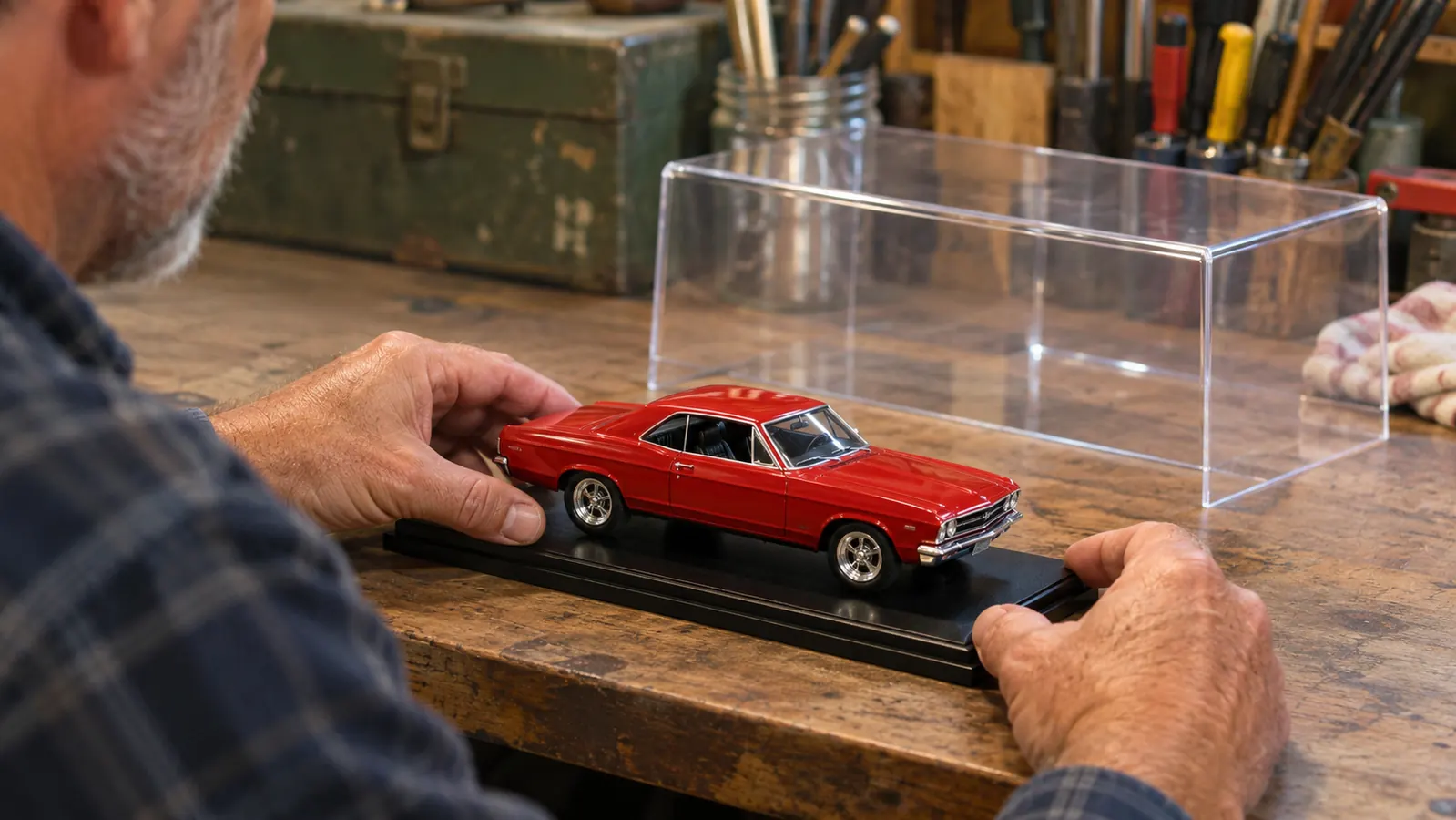
The listing gives two sets of dimensions and most people read the wrong one. The outside of the case measures 10.25 inches long, 3.75 inches wide, and 3.5 inches tall. The space your car actually occupies is what the listing calls the frame size: 9.75 inches long, 3.5 inches wide, and 2.375 inches tall. Those are two different numbers doing two different jobs, and only one of them tells you whether the car you are holding will go in.
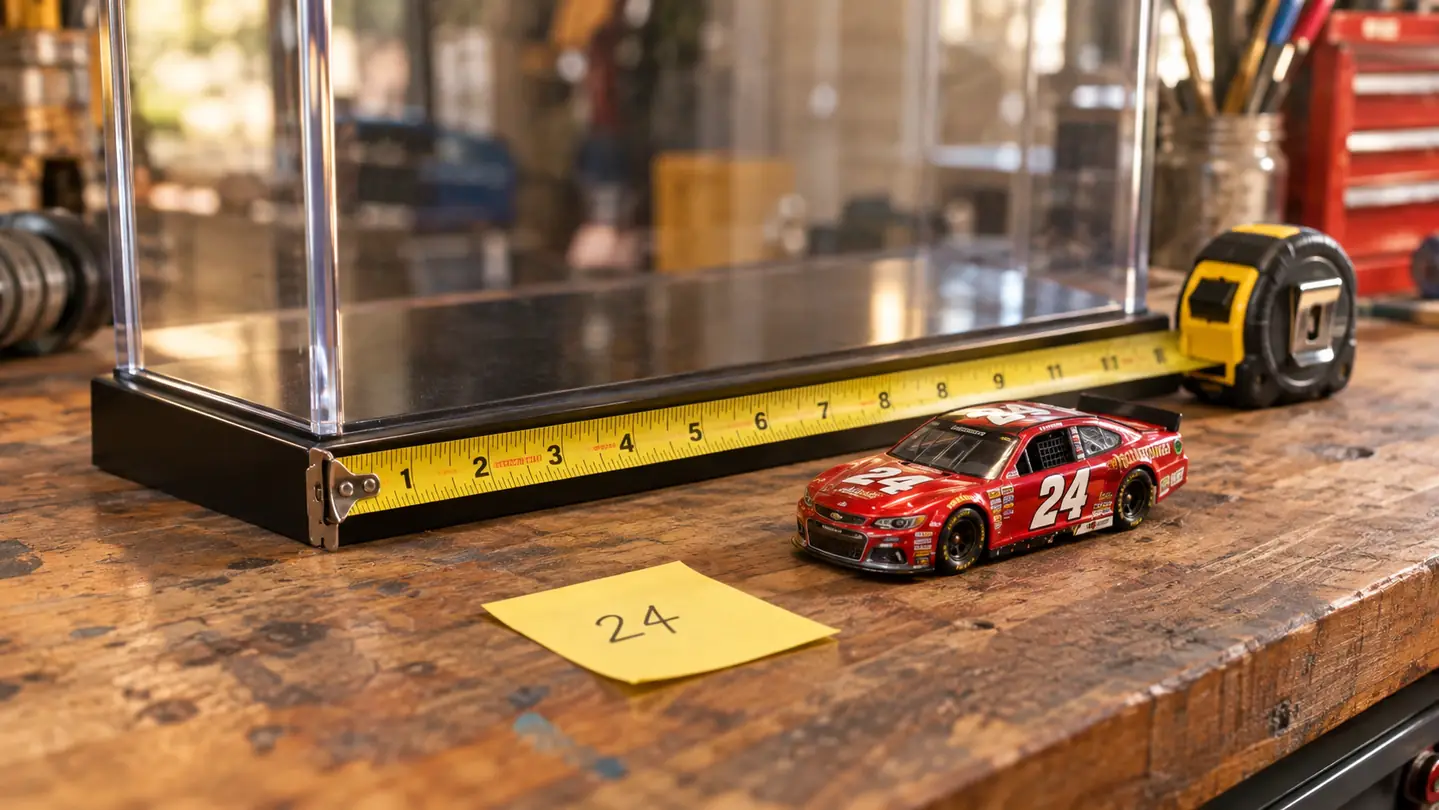
That last number is the one that bites. Length is almost never the problem with a 1:24 car. Height is. Measure your tallest casting at the roof before you order anything, and if it comes in over two and three eighths inches you have your answer before you spend a thing. I started doing that on the third case with a tape measure and a sticky note, and it has saved me at least one return and one afternoon of arguing with a shipping label.
That sticky note is still taped to the bench. It has three numbers on it from three cars I checked in a single afternoon, and the tallest of the three came in just over two and a quarter inches, which cleared with room to spare. A fourth car, one with a roof scoop, did not clear, and it still sits uncovered at the end of the shelf because I have not decided what to do with it. That is the whole tradeoff, worked out in one afternoon with a tape and a pencil.
Width is the quiet one. 3.5 inches of interior width is generous for most 1:24 cars and I have not had a single one look crowded side to side. Long cars sit fine inside 9.75 inches, with room at the nose and tail so the car does not look wedged. It is the roofline that decides it, every time, and it is the reason I keep telling people to measure instead of eyeballing the product photo.
What I Liked
- Interior length and width swallow a standard 1:24 car with room at both ends
- Clear cover keeps dust off the paint without hiding the car from across the room
- Same footprint across purchases, so a shelf of them reads as a set instead of a pile
- Base sits flat and steady, no wobble when you set a car down
- Simple enough to open and close that you will actually do it instead of leaving the cover off
Where It Falls Short
- 2.375 inches of interior height is tight for tall castings with roof scoops or big wings
- Tabletop only, with no wall mounting on it
- One case holds exactly one car, so a collection means buying units, over and over
- Acrylic scratches if you wipe it dry with the wrong cloth
- Base is hard plastic with no padding under the car
Dust, Light, and What the Case Will Not Do
Dust was the entire reason I started, and dust is where the case does its job. Two years on the oldest one, the roof of that car is as bright as the afternoon I set it in. The cover goes back on, the dust stays off, and I have not had to touch a single car with a cloth since. That is worth the shelf space to me and it is the honest core of the whole product.
What it will not do is stop light. The cover is clear acrylic, so sun still gets through it, and a basement window is still a basement window. If your worry is paint fading from sun exposure, the case is not the fix and nobody should tell you otherwise. Move the shelf out of the direct light or throw a towel over the row when the sun comes around. Buying a clear case to solve a sunlight problem is like buying a screen door to solve a mosquito problem.
Two years, six cases, and not one cover has cracked or gone cloudy. The only dust that ever got in got in on a night I left the cover sitting off on the bench.
It also will not fix a damaged car. A wing that snapped at the track or a mirror that came loose is still going to be that inside the case. What the case does is hold the car still and keep the dust off it. That is the whole promise, and once you accept the whole promise, the product makes sense and the price of it stops feeling like a question.
Handling Notes That Never Make the Listing
The cover sits on the base. It is not hinged and it is not attached, so if you pick the whole thing up by the cover you will find out about that in a hurry, and usually on a hard floor. Base down first, car second, cover third. That is the order, it takes about four seconds once you are used to it, and I have not dropped a car yet by following it.
I learned the pick-it-up-by-the-cover lesson on a Saturday in November, with the third case in one hand and a cloth in the other. The cover came off in the air, the car went down about eight inches onto the carpet, and my heart went with it. The car survived with nothing worse than a scuff on a tire. The lesson cost me a scare and nothing else, and I have carried them from the base ever since.
The acrylic will scratch. This is not a defect, it is what acrylic does, and it is true of every clear display product I have ever owned. A dry paper towel dragged across the surface leaves a haze you cannot get back out. A microfiber cloth and a little patience keeps them clear. The oldest cover in my row has one faint mark on it from a day I was in a hurry, and I see it every time I walk past. That is my fault, not BCW's, but you should know it is a thing that can happen.
The base is hard plastic with nothing under the car. That is fine for a diecast sitting still on a shelf, and it is less fine if you plan to move the case around a lot or carry it to a show. Mine do not move. They sit in one place and get dusted around twice a year. If yours will travel, set the car in carefully, keep the cover on, and carry it from the base with both hands.
The Downsides, Plainly
First, the unit math. Six cases hold six cars. If you have twenty cars, you are buying twenty cases, one at a time, and there is no version of this where that happens quickly or cheaply. It is the main reason I do not own twenty cases yet and the main reason I understand why some people go straight to a cabinet instead.
Second, the height again. I keep coming back to it because it is the one thing that turns a happy purchase into a return label. If you have a tall casting with a roof scoop, a raised spoiler, or one of those open-wheel cars with a high airbox, measure it. Do not assume, and do not trust the product photo, because the photo does not have your car in it.
Third, the case is plain. A clear cover and a base, and that is the entire design. It does its job and it does not decorate. If you want the shelf itself to carry the look, the way the glass cases in a hobby shop window do, this will feel like less than you pictured for about a week. After that you stop noticing, because what you are looking at is the car.
Reading the Amazon Reviews for What They Are
When I went back through the reviews after owning six of these, the pattern was easy to spot. The happy ones talk about dust and about how the car looks behind the cover. The unhappy ones almost always mention size. Somebody's car did not fit, or the case was smaller than they pictured, or they wanted it to hold more than one car. Almost none of that is the product failing. It is a shopper who did not read the frame size, and I say that as somebody who did not read it either on the first one.
The other review complaint worth naming is the one about it feeling light or flimsy. It is light. It is a plastic base with an acrylic cover, and it weighs about what you would guess from looking at it. What it is not is fragile in normal use. None of my six have cracked, warped, or come apart, and two of them have survived a basement that swings from humid in July to dry in January. Light and weak are not the same thing, and I think a few of those reviews are confusing the two.
One more thing about that star average. It sits around four and a half across a large pile of reviews, and when a number lands there instead of up at five, the missing half is usually a handful of fit complaints rather than a quality problem. Reading the three-star reviews first is what I do now on anything I buy, and on this case they are almost entirely about somebody else's car being too tall for the lid.
Care Over Two Years, in Plain Terms
My routine is short. Twice a year I take the covers off, wipe the outside with a microfiber cloth, blow the dust out of the inside corners, and set everything back. The cars themselves have not needed anything beyond a soft brush on the ones with a lot of small parts. No polishing, no special cleaner, no fuss. A can of compressed air and a cloth is the whole kit.
The one thing I would tell anybody starting out is to keep the covers on when the cars are not being handled, and to keep a cloth nearby for the ones you do handle. Every mark on my oldest cover came from a rushed moment, not from the product wearing out. Treat the acrylic like you would treat a pair of glasses and it will stay clear for years.
Who This Is For
You have a handful of 1:24 cars that matter to you and they are sitting out on a shelf or a dresser right now. You are tired of dusting them, or tired of watching them go dull, and you do not want to build a cabinet or give up the space one would take. You want the car visible from across the room and protected while it sits there. You are willing to measure a car before you order. That is the reader this case was built for, and it is the reason I keep buying them one at a time instead of switching to something fancier.
Who Should Skip It
Skip it if your cars run tall, because 2.375 inches of interior height is the number and no amount of wanting it to work changes that. Skip it if your plan is a wall display, since this is a tabletop piece with no mounting on it. Skip it if you want one container for a whole collection, because this holds exactly one car and there is no getting around that. And skip it if you want the display itself to be the attraction rather than the car. None of those are knocks on the case. They are just different jobs, and a wall cabinet or a bigger shelf unit is the right tool for most of them.
If the height checks out, this is the case I keep buying
Measure the roof of your tallest car first. If it clears 2.375 inches, the BCW 1:24 case does its job and then stays out of the way.
Amazon Check Today's Price on Amazon →